

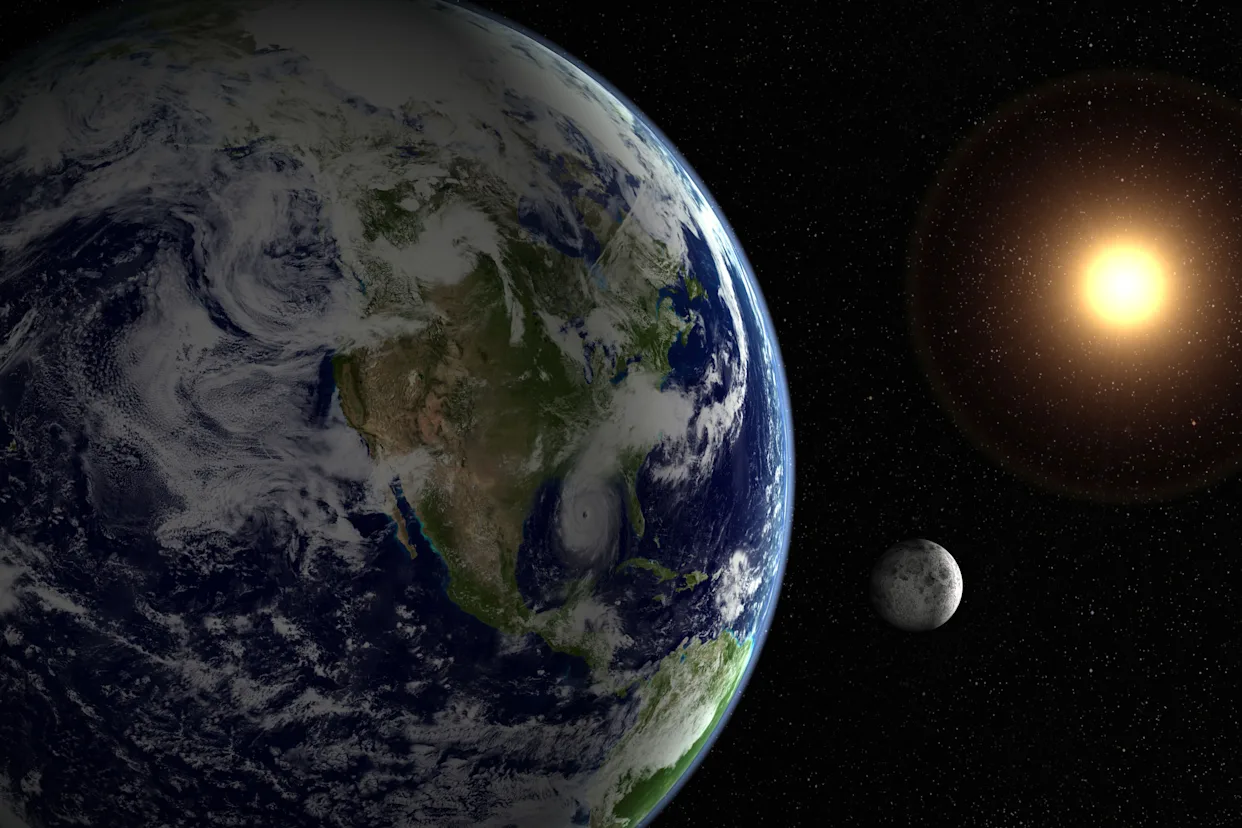
The Phenomenon of Shortened Days in 2024
Throughout history, the length of a day has been considered a stable constant, with approximately 24 hours per rotation. However, recent observations indicate a surprising shift: the Earth is spinning faster than usual, leading to shorter days in 2024. The year began with a remarkable event—on 5th July 2024, this year marked the shortest day since records began. This anomaly has sparked scientific curiosity and prompted experts to investigate the underlying causes behind this accelerated Earth’s rotation.
Understanding Earth’s Rotation and Its Variability
Earth’s rotation isn’t static; it can vary due to several geophysical factors. These include the redistribution of Earth’s mass caused by melting glaciers, seismic activities, tectonic shifts, and even the redistribution of water and air masses within the atmosphere and oceans. Such factors can cause the Earth’s moment of inertia—the measure of how much force is needed to change its rotational speed—to change slightly. When the distribution of mass shifts closer to the axis of rotation, Earth’s spin accelerates, leading to shorter days.
Key Factors Contributing to the Acceleration
- Melting Ice Caps and Glacial Recession: As glaciers and ice caps melt due to climate change, the redistribution of water redistributes the Earth’s mass, impacting its rotation. When water flows from the poles toward the equator, it can alter Earth’s moment of inertia.
- Seismic and Tectonic Activity: Large-scale earthquakes and tectonic movements can cause redistribution of Earth’s internal mass, leading to subtle changes in rotational speed.
- Atmospheric and Oceanic Circulation: Fluctuations in atmospheric pressure, jet streams, ocean currents, and other fluid movements also influence Earth’s angular momentum temporarily.
These factors contribute simultaneously, sometimes amplifying each other’s effects, creating short-term variations in Earth’s spin rate. Scientists refer to these as length-of-day (LOD) variations, which can range from milliseconds to several milliseconds short or long relative to the 24-hour cycle.
Recent Events and Predicted Shortening of Days
According to recent articles from The Indian Express and other reputable news sources reveal that the days have been shortening, sometimes by a few milliseconds, but enough to impact precise timekeeping and our daily routines.
Specifically, on 22nd July 2024, experts predicted that the Earth would have one of its shortest days in recorded history. Recent measurements indicate that the planet is indeed spinning faster, which has consequential implications—not just for science but also for technologies that rely on precise time measurement, like GPS systems and satellite navigation.
Scientific Insights Into Faster Earth Rotation
The Role of Earth’s Core and Mantle Dynamics
Earth’s internal dynamics play a crucial role in its rotational behavior. Variations in the Earth’s core, particularly the exchange of angular momentum with the solid mantle, can cause the planet’s spin to accelerate or decelerate over short time scales. For instance, changes in core-mantle coupling have been linked with fluctuations in Earth’s rotation, affecting the length of a day.
Impact of Climate Change and Global Warming
One of the more pressing explanations for recent acceleration is the melting of polar ice caps and glaciers. As mass shifts from the poles toward lower latitudes, Earth’s shape slightly becomes less oblate, which can slightly increase the rotational speed. The redistribution of water bodies, as glaciers melt into oceans, also causes changes in the overall distribution of Earth’s mass, leading to faster spins.
The Tidal and Lunar Influences
While the moon’s gravitational pull primarily causes tides and influences Earth’s rotation over very long periods, recent minor changes could also contribute to these short-term variations. However, the predominant factors are internal geophysical processes and surface mass redistribution.
Implications of Earth Spinning Faster
Timekeeping and Global Synchronization
Shortening of days prompts international timekeeping organizations, such as the International Earth Rotation and Reference Systems Service (IERS), to consider adjustments. There is talk of implementing Leap seconds—additional seconds added to Coordinated Universal Time (UTC)—to keep our clocks aligned with Earth’s actual rotation. The increasing frequency of these adjustments could eventually lead to reconsiderations of how we define a day.
Technological Challenges and Adjustments
Global positioning systems, satellite communications, and even financial markets depend on precise time synchronization. Faster Earth’s rotation introduces minor but significant corrections needed to maintain technical accuracy. Failure to account for these variations could affect navigation accuracy, data timestamping, and scientific experiments.
Long-term Trends and Future Predictions
Scientists believe that Earth’s spin acceleration might be temporary, influenced by cyclical geophysical processes. However, ongoing climate change could prolong some of these effects. Models suggest that over the coming decades, Earth’s rotation could continue to vary, making the task of precise timekeeping increasingly complex. There is also speculation about the potential for long-term deceleration due to gravitational interactions, but such effects manifest over millennia.
Conclusion: What Does This Mean for Us in 2024?
The acceleration of Earth’s rotation and the consequent shortening of our days is a fascinating natural phenomenon driven by complex interactions within our planet complemented by surface environmental changes. While the changes are subtle and not noticeable in daily life, their implications for scientific precision and global timekeeping are significant. As climate change progresses and our understanding of Earth’s internal dynamics deepens, monitoring these variations becomes more critical.
In essence, 2024 stands out as a year when our planet’s rotational behavior reminded us of its dynamic and ever-changing nature. Continuous research and advancements in geophysics are essential to predict and adapt to these variations, ensuring our technological systems stay synchronized with Earth’s rhythms.
**For more updated news please keep visiting Hourly Prime News.**