

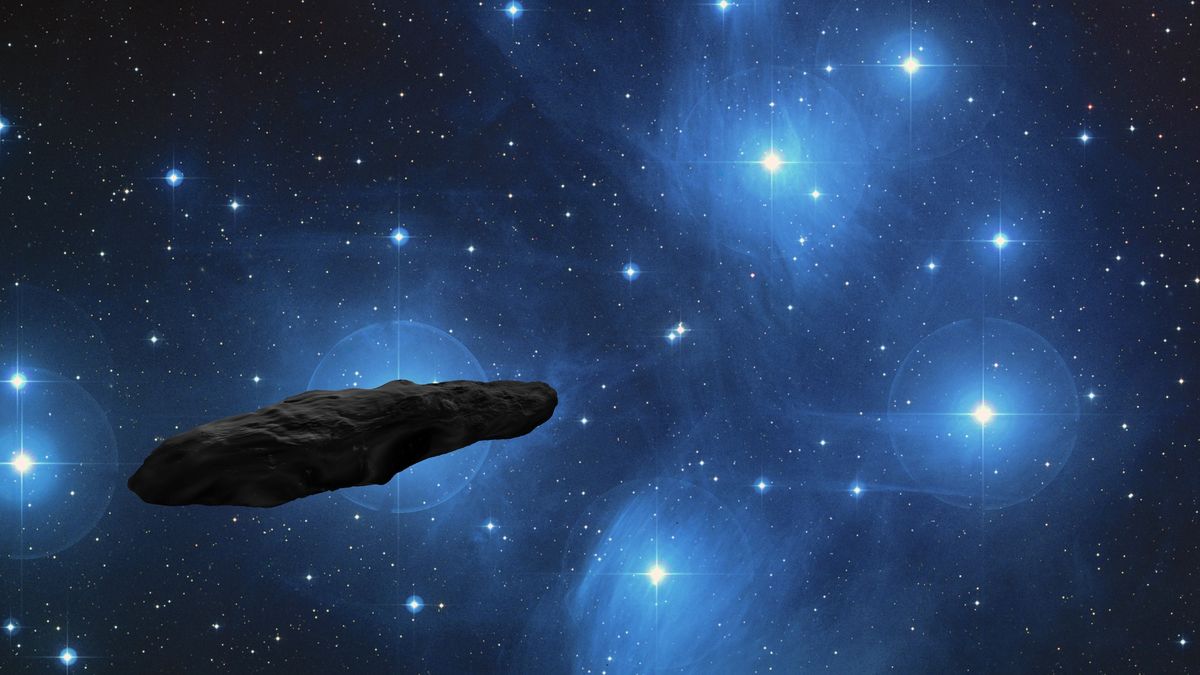
An Interstellar Visitor with Unprecedented Significance
The discovery of 3I/ATLAS—an interstellar object passing through our solar system—has sparked intense debates among scientists and space enthusiasts. While most celestial bodies, such as comets and asteroids, originate within our solar system, 3I/ATLAS is unique. Its high velocity and trajectory indicated that it originated from outside our solar neighborhood, making it an interstellar visitor. But what truly captured the imagination of scientists like Harvard astrophysicist Avi Loeb is the possibility that this object might not be a natural phenomenon at all. Instead, Loeb suggests that 3I/ATLAS could potentially be an alien-made artifact, a spacecraft sent intentionally for exploration or study.
Avi Loeb’s Bold Hypothesis
Loeb’s hypothesis rests on groundbreaking observations and a willingness to entertain extraordinary explanations for extraordinary phenomena. His assertion that 3I/ATLAS could be an artificial object challenges the traditional view that all celestial visitors are natural. His stance has garnered both skepticism and intrigue, highlighting a broader scientific conversation about how we interpret data related to mysterious interstellar objects.
Three Compelling Reasons Supporting Alien Technology Theory
1. Anomalous Physical Characteristics
One of the primary reasons Loeb leans towards an extraterrestrial origin is due to the physical properties of 3I/ATLAS. Observations suggested that the object had a very unusual shape and behavior not typical of natural celestial bodies. For instance, it exhibited an unexpected acceleration that could not be explained solely through gravitational influences. Additionally, its brightness variations and the way it reflected sunlight suggested an irregular, possibly engineered, surface structure. These features are analogous to how humans shape and design spacecraft or artificial objects, leading Loeb to consider the possibility of an artifact rather than a naturally formed body.
2. Lack of Cometary Activity
Traditionally, comets originating from the outer solar system show clear signs of sublimation—where ice and frozen gases vaporize as they approach the Sun—resulting in glowing comas and tails. However, see relevant reports, early data indicated that 3I/ATLAS lacked typical cometary activity, further fueling speculation that it might be an engineered object with an intended purpose, rather than a passing natural body.
3. The Possibility of Extraterrestrial Engineering
While natural explanations can account for many cosmic phenomena, Loeb advocates considering the extraordinary possibility—that 3I/ATLAS could be an alien construct. The idea aligns with the concept of technosignatures: signs of technology or engineering that could be detected through their physical or behavioral signatures. For example, some researchers have suggested that unusual features of interstellar objects might indicate artificial origin, such as high reflectivity, tessellated surfaces, or trajectories inconsistent with natural physics. Loeb posits that since humanity has developed the capability to engineer spacecraft and satellites, it’s plausible that an advanced extraterrestrial civilization could have done the same, especially if their technology surpasses our current understanding.
Supporting Evidence from Recent Space Observations
In addition to Loeb’s hypotheses, recent observations have added fuel to the debate. The Hubble Space Telescope captured see recent images of interstellar objects entering our solar system. These data points, while still inconclusive, are intriguing in the context of the possibility that some of these objects might be remnants or artifacts of alien engineering efforts.
The Scientific and Philosophical Implications
Loeb’s bold stance opens the door to a profound shift in how humanity perceives its place in the universe. Discovering evidence of alien technology would be one of the most significant scientific breakthroughs in history. It would suggest that intelligent extraterrestrial civilizations not only exist but are technologically capable of visiting or sending probes to our star system. Such a revelation would ignite new fields of research, ethics considerations, and philosophical debates about extraterrestrial life and humanity’s role in the cosmos.
However, it’s crucial to consider that Loeb advocates for scientific skepticism and rigorous investigation. His hypothesis does not claim definitive proof but emphasizes the importance of exploring unconventional possibilities with an open mind, especially when data points toward anomalies that challenge our current understanding.
Conclusion
In the face of mysterious interstellar visitors like 3I/ATLAS, Avi Loeb’s hypothesis that these could be alien technology remains both provocative and compelling. While more data and research are necessary to draw concrete conclusions, the notion pushes us to expand our scientific horizons and prepare for discoveries that could redefine our understanding of the universe. The ongoing efforts to observe and analyze interstellar objects continue to hold the potential to reveal secrets that may, one day, confirm that we are not alone.
For more updated news please keep visiting Hourly Prime News.