

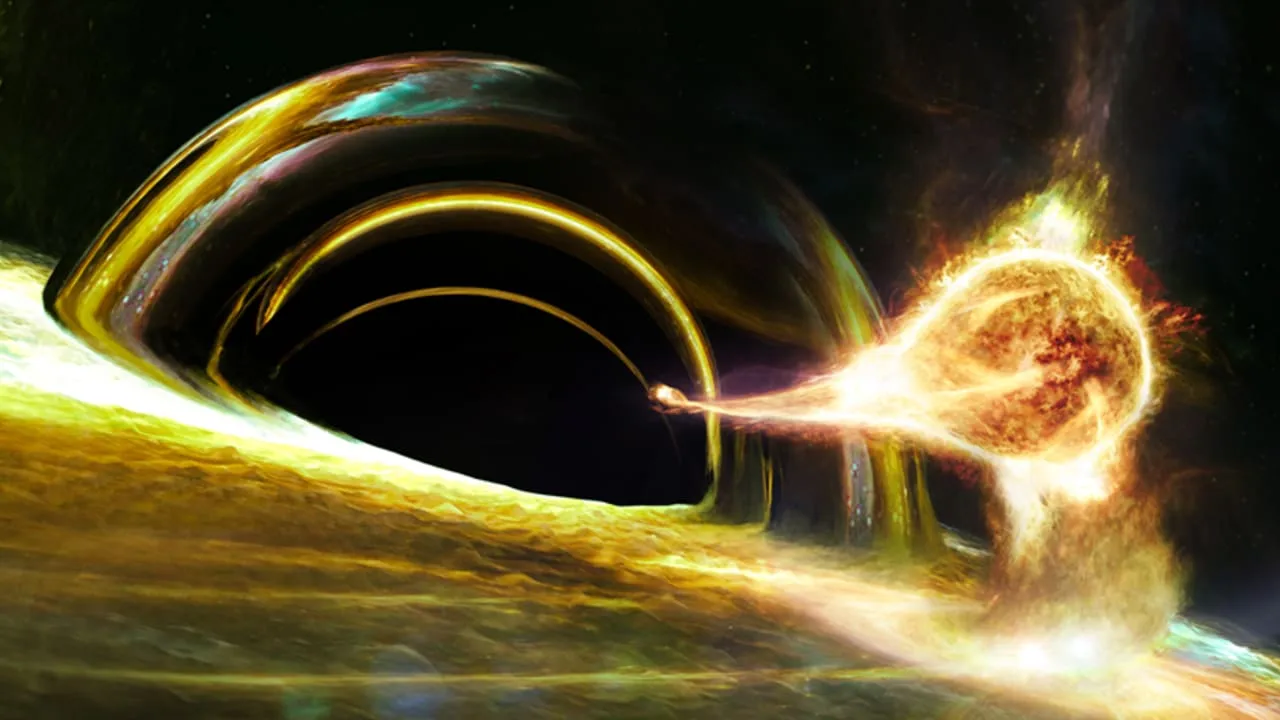
The universe continues to surprise astronomers and astrophysicists with its incredible phenomena, especially when celestial objects demonstrate resilience in ways that challenge our understanding. One of the most fascinating recent discoveries involves a star that not only survived an encounter with a supermassive black hole but intriguingly returned for a subsequent interaction. This extraordinary event is reshaping theories about black hole behavior, star survival, and the dynamic interactions within the dense cores of galaxies.
Unraveling the Incredible Escape of a Star from a Black Hole
The incident begins with a supermassive black hole—an entity millions to billions of times the mass of our Sun—located at the heart of a distant galaxy. Black holes are notorious for their immense gravitational pulls, capable of devouring stars and even light. Typically, when a star ventures too close, the intense gravitational forces can tear it apart in what is known as a tidal disruption event (TDE). However, recent observations reveal a rare case where a star narrowly escaped this fate and managed to leave the black hole’s violent grip.
This event was highlighted in a detailed report titled This star escaped a supermassive black hole’s violent grips — then returned for round 2.
The Mechanics of a Narrow Escape
Scientists believe that this star’s escape was possible due to its trajectory and velocity at the moment of closest approach. In some rare instances, a star passing near a black hole can avoid complete destruction if it approaches just outside the tidal radius—the critical distance at which black hole tidal forces would otherwise shred it apart. Instead, the star experiences intense gravitational stress but manages to survive, propelled away at an incredible speed. Such an event suggests that the star’s encounter was an extremely close but not catastrophic pass.
Further analysis indicates that the star’s survival is not just a cosmic anomaly but might also involve complex gravitational interactions within the galactic core, possibly influenced by other massive objects or the black hole’s spin. This case prompts a reevaluation of existing models related to stellar disruption, as it shows that survival is more plausible than previously believed under certain conditions.
The Return of the Resilient Star
Even more astonishing is the subsequent detection of the same star returning to the vicinity of the black hole for a second encounter. As detailed in an article titled A star survives destructive black hole encounter and returns — Here’s why astronomers are surprised.
Implications of the Return
The star’s reappearance close to the black hole indicates that the interactions within galactic centers are more nuanced than previously thought. It raises questions about the conditions that allow a star to survive initial close encounters and then subsequently return. This could imply that some stars are resilient enough to withstand partial destruction, or perhaps the black hole’s gravity causes complex orbital paths that bring the star back into its pull after initial escape.
This discovery challenges the traditional view that black hole encounters are inevitably destructive for stars, particularly in the case of supermassive black holes at galactic centers. Instead, it proposes a new perspective where stellar survival and repeated close approaches are plausible, prompting scientists to refine their models of stellar dynamics around black holes.
What This Discovery Means for Future Research
Such groundbreaking observations open numerous avenues for further research. Astronomers now aim to understand the physical processes that enable survival, the range of conditions under which stars can escape black holes, and the frequency of such events across the universe. Additionally, the return of a defiant star suggests that there could be many more unseen survivors in the vicinity of black holes, waiting to be discovered with advanced telescopes and observational techniques.
Moreover, these findings could influence our understanding of black hole feeding mechanisms and their growth over cosmic time. If stars can survive multiple close encounters, it may alter assumptions about how black holes accumulate mass—potentially through a combination of destruction and the capture of resilient stars.
Broader Perspectives in Black Hole and Stellar Astrophysics
The phenomenon also prompts questions about the effects such encounters have on the star’s structure and lifecycle. Could repeated close approaches impact the star’s evolution? Might these encounters trigger bursts of stellar activity or surface explosions? Such events could, in turn, produce observable phenomena like jet emissions, X-ray bursts, or gravitational waves, providing new signals for astronomers to detect.
Simultaneously, this discovery emphasizes the dynamic and chaotic environment at the core of galaxies. It underscores the importance of continuous monitoring and detailed simulations to unveil the complex gravitational ballet taking place there. As our observational methods improve, so will our capacity to decode these extraordinary cosmic interactions.
Conclusion
The story of a star that defies destruction and makes a second return after a close encounter with a supermassive black hole is a testament to the universe’s immense and surprising resilience. It challenges established theories, opens new lines of inquiry, and highlights the ever-evolving nature of astrophysics. As scientists delve deeper into these phenomena, we may soon uncover even more astonishing aspects of how stars and black holes interact, survive, and influence the cosmos.
For more updated news please keep visiting Hourly Prime News.