

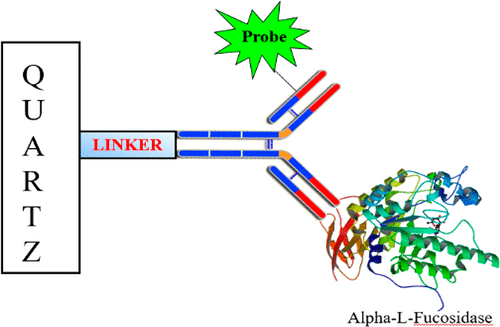
Gliomas represent some of the most aggressive and lethal primary brain tumors, posing significant challenges in diagnosis, prognosis, and treatment management. As the scientific community continues to explore novel biomarkers for better stratification of glioma patients, the role of specific enzymatic isoenzymes has garnered increasing attention. Among these, the α-L-fucosidase isoenzymes (FUCA1 and FUCA2) have emerged as promising molecular markers that could potentially enhance our understanding of tumor behavior and patient outcomes. Recent research, including comprehensive studies published in BMC Cancer, highlights the prognostic value of these enzymes in glioma pathology.
Understanding α-L-fucosidase Isoenzymes: FUCA1 and FUCA2
α-L-fucosidase (FUCA) is a lysosomal enzyme involved in the hydrolysis of fucosylated glycoproteins and glycolipids, playing an essential role in cellular metabolism and remodeling of the glycan structures on cell surfaces. Human α-L-fucosidase exists primarily in two isoenzyme forms: FUCA1, predominantly expressed in lysosomal compartments across various tissues, and FUCA2, which is usually associated with the gastric mucosa but also found in other tissues, including the brain.
These isoenzymes are coded by separate genes and exhibit distinctive expression profiles that respond differently to cellular and pathological factors, including tumor development. The differential activity of FUCA1 and FUCA2 has raised questions about their specific roles in tumor biology—particularly whether they can serve as reliable biomarkers for prognosis in glioma patients.
The Link Between FUCA Isoenzymes and Glioma Pathophysiology
Recent research suggests that alterations in the activity levels of FUCA1 and FUCA2 are associated with glioma progression and patient survival. The biological rationale for this connection lies in the function of fucosylated glycans in cell signaling, adhesion, and immune evasion—processes crucial to tumor development and metastasis.
Elevated or decreased levels of FUCA isoenzymes can influence the tumor microenvironment, affecting tumor cell motility, invasion capabilities, and response to therapy. For example, abnormal enzyme activity may modify glycan structures on tumor cell surfaces, thus impacting how immune cells recognize and attack malignant cells.
Key Findings from Recent Comprehensive Studies
A landmark study published in BMC Cancer provides an in-depth analysis of the prognostic significance of FUCA1 and FUCA2 in glioma patients. The research involved measuring enzyme activity levels in tumor tissues and correlating these with clinical outcomes, including overall survival, progression-free survival, and response to conventional treatments.
Major findings from this research include:
- Distinct expression patterns: FUCA1 tends to be upregulated in high-grade gliomas, correlating with poorer prognosis, while FUCA2 shows a varied expression depending on tumor grade.
- Prognostic value: Elevated FUCA1 activity levels are associated with increased tumor aggressiveness and decreased survival rates among glioma patients.
- Potential as therapeutic targets: Modulating FUCA enzyme activity could open new pathways for therapeutic intervention, potentially improving patient responses to existing treatments.
- Predictive power: Combining FUCA isoenzyme activity measurements with other molecular markers enhances accuracy in predicting patient outcomes.
Clinical Implications and Future Perspectives
The identification of FUCA1 and FUCA2 as prognostic markers offers several promising avenues for clinical implementation:
- Personalized treatment approaches: Stratifying patients based on FUCA isoenzyme profiles might guide clinicians in tailoring therapies more effectively, perhaps indicating who might benefit from more aggressive treatments or targeted therapies.
- Early detection and monitoring: Measuring enzyme activity levels could be useful in disease monitoring, assessing response to treatment, or detecting recurrence earlier than conventional imaging techniques.
- Development of targeted therapies: Research into inhibitors or enhancers of FUCA isoenzymes could pave the way for novel treatments aimed at modifying tumor microenvironment and suppressing tumor growth.
Despite these encouraging findings, it is essential to note that further validation in larger, multi-center cohorts is necessary before FUCA isoenzymes can be integrated into routine clinical practice. Technological advancements in assay sensitivity and specificity, along with deeper understanding of the molecular mechanisms involved, will be crucial to translate these biomarkers from bench to bedside.
Conclusion
The comprehensive study of α-L-fucosidase isoenzymes (FUCA1 and FUCA2) underscores their potential as vital prognostic markers in glioma outcomes. Their differential expression and activity levels not only reflect tumor behavior but also open avenues for innovative diagnostic and therapeutic strategies. As our understanding of glycosylation in cancer deepens, these enzymes could become pivotal in guiding personalized medicine approaches, ultimately improving survival and quality of life for glioma patients.
As research progresses, integrating FUCA isoenzymes into the molecular profiling of gliomas could revolutionize how we predict prognosis and manage treatment plans. Continual exploration into their biological functions will further delineate their role in tumor biology and may offer new targets for intervention.
For more updated news please keep visiting Hourly Prime News.