

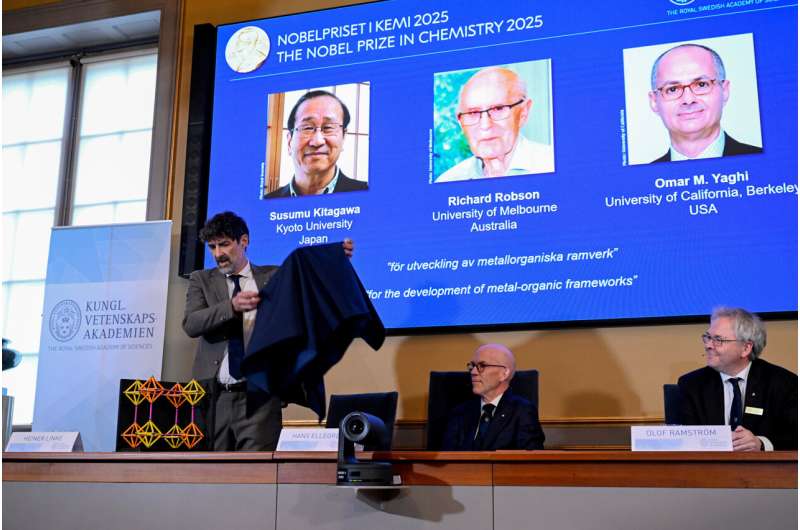
The Nobel Prize in Chemistry, one of the most prestigious awards in the scientific community, has recently been awarded to a trio of pioneering scientists for their groundbreaking work on metal–organic frameworks (MOFs). This recognition underscores the transformative impact that MOFs are poised to have across multiple fields, from environmental science to material engineering.
The Breakthrough Work of the Nobel Laureates
Understanding Metal–Organic Frameworks (MOFs)
Metal–organic frameworks are crystalline materials composed of metal ions or clusters coordinated to organic ligands. This unique architecture results in materials with an exceptionally high surface area, tunable pore sizes, and remarkable chemical stability. Their modular design allows scientists to precisely tailor properties for specific applications, making them a focal point for cutting-edge research.
The Pioneering Contributions That Led to Nobel Recognition
The recent Nobel laureates—**Susumu Kitagawa**, **Richard Robson**, and **Omar Yaghi**—have significantly advanced our understanding and synthesis of MOFs. Their work has enabled the creation of customizable frameworks that can serve as molecular sieves, catalysts, or storage units for gases like hydrogen and carbon dioxide. This technological leap not only provides new insights into porous materials but also opens avenues for environmentally sustainable solutions such as carbon capture and clean energy storage.
The Impact of Their Research on Science and Society
The importance of MOFs extends beyond academic curiosity. These materials hold immense potential in real-world applications:
- Environmental Remediation: MOFs can selectively trap pollutants or greenhouse gases, offering effective strategies for combating climate change.
- Energy Storage: They can be used to develop high-capacity batteries and supercapacitors, facilitating the transition to renewable energy sources.
- Catalysis and Chemical Manufacturing: Their tunable pore structures make them ideal for catalyzing chemical reactions more efficiently and selectively, reducing waste and energy consumption.
- Medical and Biological Applications: Emerging research suggests MOFs can be employed in drug delivery systems and biosensing, highlighting their versatility.
The Path Forward: Innovation Driven by Nobel-Led Discoveries
The award not only celebrates past achievements but also energizes ongoing research. Scientists worldwide are now leveraging the frameworks developed by the laureates to engineer materials with enhanced functionalities. For instance, custom-designed MOFs are being explored for capturing industrial emissions or storing renewable fuels, aligning scientific innovation with global sustainability goals.
Furthermore, the structural versatility of MOFs continues to inspire new synthetic strategies, leading to the discovery of variants with unprecedented properties. The integration of MOFs with other nanomaterials and their incorporation into devices for real-world applications are promising avenues for future research.
Broader Implications and Future Challenges
While the potential of MOFs is vast, translating laboratory discoveries into scalable commercial products remains a challenge. Factors such as cost-effective synthesis, long-term stability, and environmental impact need careful consideration. Nevertheless, the awarded scientists have laid a robust foundation for addressing these issues, guiding the material science community toward innovative solutions that could revolutionize multiple industries.
Global Recognition of Scientific Excellence
The awarding of the Nobel Prize to these scientists highlights a crucial trend: the increasing recognition of materials science and chemistry as vital drivers of technological progress. As MOFs continue to evolve, their contributions are expected to influence sectors including energy, manufacturing, and environmental management profoundly.
Conclusion
The Nobel Prize in Chemistry for advances in metal–organic frameworks marks a milestone in recognizing the transformative power of innovative materials science. The pioneering work of Kitagawa, Robson, and Yaghi exemplifies how fundamental research can lead to practical solutions for some of humanity’s most pressing challenges. As research continues and new applications emerge, MOFs are poised to become central to sustainable technological development.
For more updated news please keep visiting Hourly Prime News.