

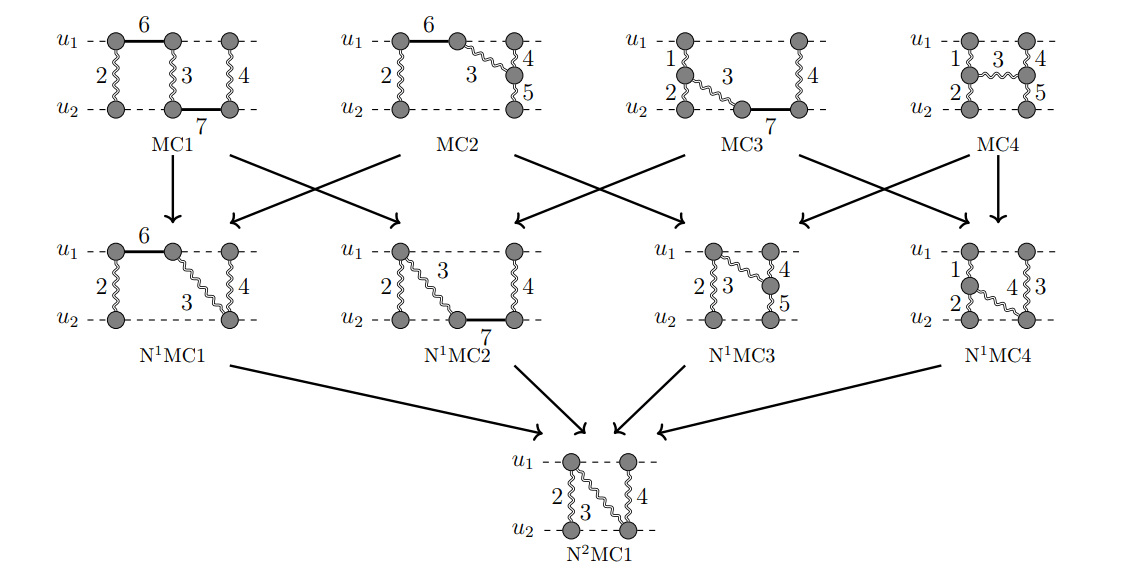
Recent advancements in theoretical physics have opened new pathways to understanding gravitational waves with unprecedented precision. The application of innovative computational techniques, particularly the Generalized Unitarity Method, is revolutionizing the way scientists calculate gravitational waveforms at higher orders of perturbation theory. Moving beyond traditional Feynman diagram approaches, this methodology not only simplifies complex calculations but also enhances our capacity to generate accurate predictions crucial for gravitational wave astronomy.
Understanding the Significance of Higher-Order Gravitational Waveforms
Gravitational wave detection, epitomized by landmark observations such as those by LIGO and Virgo, relies heavily on highly precise theoretical models of waveform signals. These models are necessary to decode the signals emanating from cataclysmic astrophysical events like black hole mergers and neutron star collisions. To match the sensitivity of modern detectors, scientists require waveform templates that incorporate higher-order corrections—specifically, the Next-to-Leading Order (NLO) terms in the perturbative expansion of gravitational interactions.
Traditional computational strategies for generating these higher-order waveforms involve Feynman diagrams, which, while systematic, become prohibitively complicated as the order of perturbation increases. The proliferation of diagrams and integrals induces significant computational complexity, often making NLO calculations a bottleneck for accurate modeling.
The Generalized Unitarity Method: A New Paradigm
What is the Generalized Unitarity Method?
The Generalized Unitarity Method is a powerful technique originally developed within quantum field theory to compute scattering amplitudes efficiently. Instead of summing over a vast array of Feynman diagrams, this approach reconstructs the complete amplitude by considering its unitarity cuts—essentially, cutting propagators to expose simpler building blocks of the interaction.
By extending the traditional unitarity method, the generalized version allows for the systematic reconstruction of loop amplitudes from on-shell tree-level amplitudes, significantly streamlining calculations. This method harnesses the analytic properties of scattering amplitudes, leveraging complex analysis and on-shell techniques to bypass redundant calculations inherent in Feynman diagram approaches.
Adapting the Method for Gravitational Waveforms
While initially formulated in the context of particle physics, recent research has demonstrated the applicability of the generalized unitarity approach to gravitational interactions. In particular, it enables the calculation of higher-order gravitational waveforms by relating complex loop integrals to products of simpler on-shell amplitudes, leading to more manageable calculations at the NLO level.
This adaptation involves several key steps:
- Decomposition of the amplitude: Breaking down the gravitational interaction into on-shell components.
- Performing unitarity cuts: Systematically “cutting” propagators to factorize the amplitude into tree-level parts.
- Reconstruction of the integrand: Assembling the full correction by combining these on-shell pieces, effectively bypassing the laborious diagrammatic calculations.
Advantages of the Generalized Unitarity Method in Gravitational Wave Calculations
The advantages of employing this technique are manifold, particularly for computations relevant to gravitational wave physics:
- Reduction of Computational Complexity: Significantly less cumbersome than traditional Feynman diagram techniques, especially at higher loops or correction orders.
- Enhanced Accuracy: Facilitates precise NLO calculations that are crucial for matching observational data with theoretical models.
- Physical Transparency: The on-shell approach aligns well with physical intuition, often making the underlying physical processes more transparent.
- Efficiency in Loop Integrals: Better handling of loop integrations, which are typically problematic in standard perturbation theory.
Case Studies and Recent Developments
Recent research articles, such as the one titled “Generalized Unitarity Method Computes Gravitational Waveforms to Next-to-Leading Order, Avoiding Feynman Diagrams” from Quantum Zeitgeist highlights the cutting-edge application of these techniques.
These studies demonstrate that the generalized unitarity approach not only simplifies long-standing calculations but also enables physicists to push beyond the LO (Leading Order) approximations, yielding NLO predictions that are essential for the next generation of gravitational wave detectors.
Impact on Gravitational Wave Astronomy
The integration of advanced computational techniques like the generalized unitarity method into gravitational waveform modeling holds the promise of transforming gravitational wave astronomy:
- More Accurate Templates: Precise waveform templates improve the signal-to-noise ratio in data analysis, increasing detection sensitivity.
- Deeper Astrophysical Insights: Better models allow astronomers to extract additional information about the source parameters of gravitational wave events.
- Testing Fundamental Physics: Higher-order corrections may reveal subtle effects predicted by alternative theories of gravity or quantum gravity effects.
- Enhanced Multi-Messenger Astronomy: Improved waveform predictions complement electromagnetic observations, providing a holistic understanding of cosmic phenomena.
Future Directions and Challenges
Despite the significant progress, there remain challenges in extending the generalized unitarity method to even higher orders or more complex systems:
- Loop Complexity: As calculations incorporate higher loops, the combinatorial complexity grows, requiring further methodological innovations.
- Inclusion of Finite-Size Effects: Accurately modeling extended sources like neutron stars demands additional theoretical considerations.
- Integration with Numerical Relativity: Bridging analytical NLO results with numerical simulations remains an ongoing area of research.
Nevertheless, ongoing research and technological advancements continue to expand the boundaries of what is computationally feasible, promising a future where gravitational waveform modeling is both highly accurate and computationally efficient.
Conclusion
The application of the Generalized Unitarity Method to the computation of gravitational waveforms at NLO marks a transformative development in the field of gravitational physics. It exemplifies the fruitful collaboration between particle physics techniques and astrophysical applications, leading to more precise models that will enhance the scientific return of gravitational wave observatories worldwide.
In the era of gravitational wave astronomy, such innovative approaches are vital for unlocking the secrets of the universe’s most energetic events, improving our understanding of gravity, and testing the fundamental laws of physics under extreme conditions.
As research continues, the integration of these advanced computational methods promises to drive the next wave of discoveries, revealing ever more about the cosmos.
For more updated news please keep visiting Hourly Prime News.