

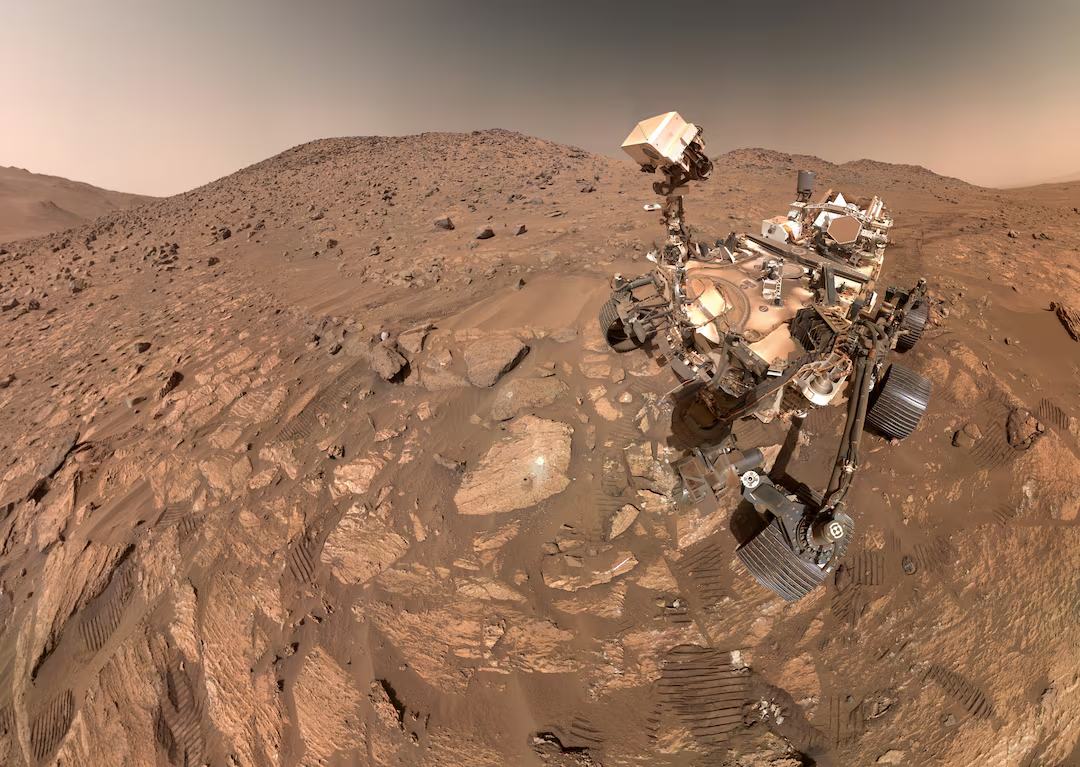
The quest to find signs of past or present life beyond Earth has always been a cornerstone of planetary science. Recently, NASA’s rover mission on Mars has taken a significant leap forward with the discovery of what are being termed “Leopard-spot” rocks—geological formations that may hold the clearest evidence yet of ancient biological activity on the Red Planet. This breakthrough has invigorated the scientific community, sparking discussions about the possibility of extraterrestrial life and reshaping our understanding of Mars’ history.
The Significance of the Leopard-spot Rocks
The Leopard-spot rocks have garnered attention because of their distinctive appearance and the mineralogical clues they contain. These rocks exhibit a pattern reminiscent of the spots on a leopard, characterized by contrasting mineral compositions and textures. According to recent reports from CNBC TV18, this pattern is not merely aesthetic—it indicates complex geological processes potentially linked to environments conducive to life.
The key lies in the mineral associations and organic signatures detected within these rocks. Researchers suggest that such patterns could be evidence of microbial activity or biosignatures preserved over billions of years. The presence of specific minerals associated with redox reactions and organic compounds is particularly compelling, as these are often signs of biological processes.
Technical Findings: Organic and Redox Signatures
A detailed study published in Nature highlights the significance of redox-driven mineral associations found in the Jezero Crater, where the rover is currently exploring. The detection of minerals formed through redox reactions implies that the environment had fluctuating oxygen levels—conditions that can support microbial life.
Furthermore, analysis of the mineralogy reveals associations with organic compounds, which are fundamental building blocks of life. The possibility that these organic signatures could be remnants of ancient microorganisms bolsters the hypothesis that Mars once hosted conditions suitable for life.
Notably, NASA has previously announced potential biosignatures identified last year, adding depth to this discovery. These signs include mineralogical features that, in terrestrial contexts, are indicative of biological activity. The current findings extend this narrative, suggesting that the “Leopard-spot” rocks might be home to or have preserved evidence of ancient life forms.
Historical Context and Previous Discoveries
This discovery is not an isolated incident but part of a broader pattern of findings that support the idea of past habitability on Mars. Last year’s reports from NASA revealed potential biosignatures—specific mineral and organic associations—that could signify microbial life. Furthermore, other studies have identified redox-driven mineral formations indicative of water-rich environments that could have supported life.
The current investigation capitalizes on advanced analytical tools on the rover, such as spectrometers and high-resolution imaging, revealing the complex interplay of minerals within these rocks. The imagery and data suggest that these rocks have undergone aqueous alteration processes, further hinting at a once-active water cycle on Mars.
Implications for the Search for Life
The implications of these findings are profound. If the Leopard-spot rocks indeed contain biosignatures, it would be a historic milestone—affirming that Mars once bore the ingredients and environmental conditions necessary for life. This would also influence future exploration strategies, prioritizing similar mineral formations for investigation.
Scientists are now looking at these patterns and signatures as potential “snapshots” of Mars’ biological history. Confirming life would not only reshape planetary science but also inspire questions about life’s universality and the possibility of discovering extraterrestrial organisms elsewhere.
Future Steps and Ongoing Research
The journey to definitively establish whether the Leopard-spot rocks harbor signs of life is ongoing. Laboratory analyses, perhaps involving sample return missions, are essential to verify the organic and mineralogical indicators detected. Advances in remote sensing and in-situ analysis will continue to refine our understanding of these rocks.
NASA’s team is also examining other locations within Jezero Crater for similar geological features. The detection of redox-driven minerals and organic compounds across different sites adds confidence to the hypothesis that Mars possessed habitable environments in its distant past.
Looking ahead, upcoming missions aim to return samples to Earth for comprehensive laboratory testing, which could provide irrefutable evidence of ancient life, if present. The Leopard-spot rocks serve as a tantalizing hint, guiding future explorations in the ongoing search for extraterrestrial biology.
Conclusion: A New Chapter in Mars Exploration
The discovery of the Leopard-spot rocks represents a potentially historic turning point in Martian science. While definitive proof of life remains a goal, these findings open exciting avenues for research and exploration. With each new piece of evidence, we inch closer to answering fundamental questions about the origins of life and our place in the cosmos.
As scientific efforts continue, the image of Mars as a once-habitable world gains clarity, fueling curiosity and inspiring the next generation of explorers.
For more updated news please keep visiting Hourly Prime News.