

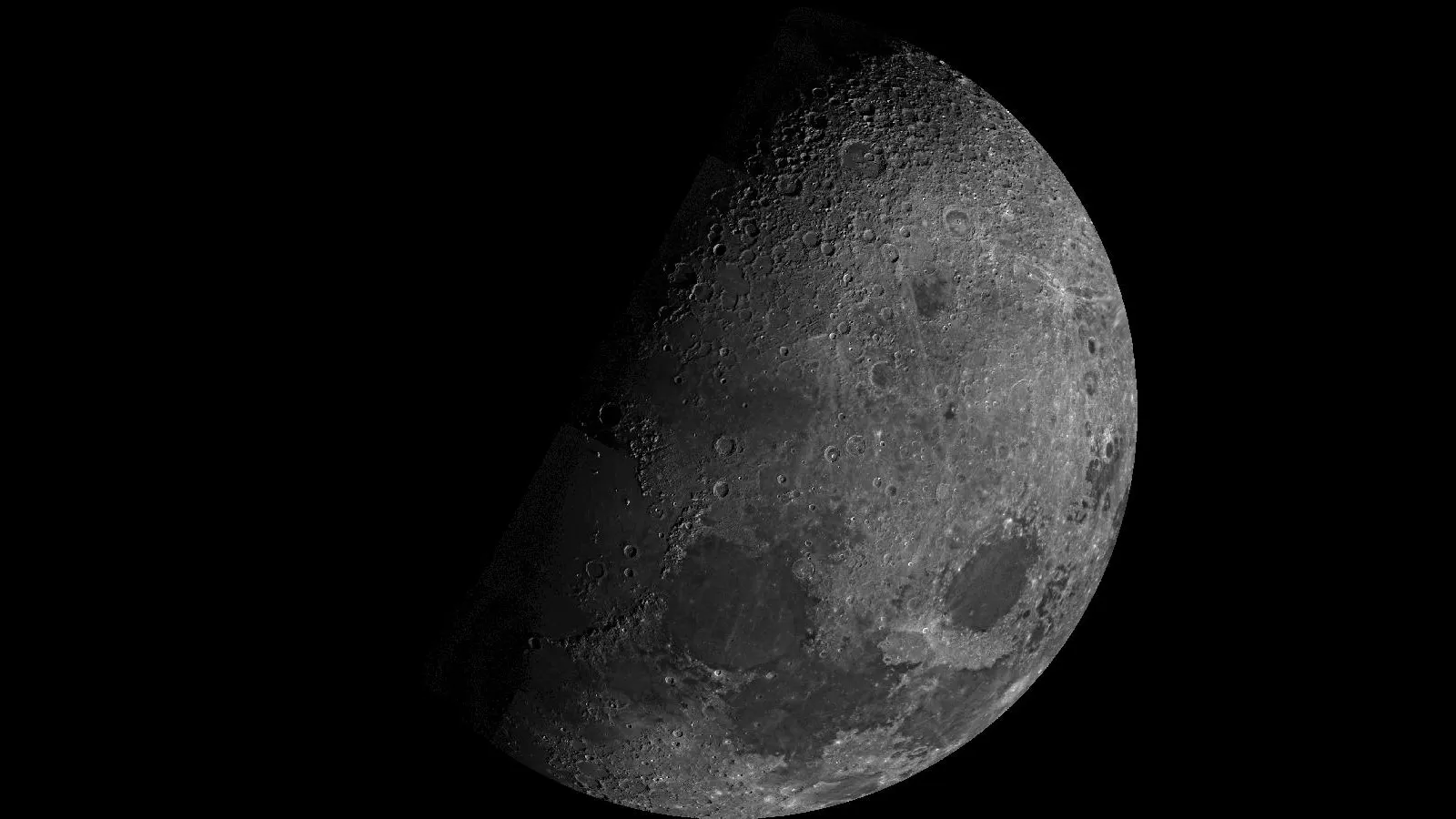
In a groundbreaking revelation that has perplexed scientists around the globe, recent studies have confirmed the presence of *haematite* (a form of rust) on the Moon’s polar regions. Traditionally, the Moon has been considered a lifeless, inert body devoid of active geological processes like rusting, which is typically associated with the presence of liquid water and oxygen on Earth. However, this discovery challenges conventional wisdom and suggests an intriguing connection between Earth’s environment and lunar surface chemistry.
Understanding Hematite and Its Significance
Hematite is a mineral form of iron oxide and is widely recognized on Earth as a primary indicator of oxidation processes involving water and oxygen. Its presence in lunar polar regions is not just a scientific curiosity but also an indicator of complex environmental interactions. The detection of hematite is significant because it signals processes that are usually tied to the presence of liquid water or atmospheric oxygen—elements traditionally considered absent on the Moon.
Recent observations, as detailed in various scientific reports, suggest that hematite on the Moon is not a result of in-situ lunar processes alone but is likely influenced by external factors, possibly originating from Earth itself. This opens up fascinating questions: How did hematite form on the Moon? What does it reveal about lunar geology and history? And, crucially, what role does Earth play in this unusual lunar phenomenon?
How Earth Might Be Contributing to Lunar Hematite Formation
Multiple scientific theories have emerged to explain this perplexing phenomenon, with many pointing towards Earth’s influence. Here are some of the leading hypotheses:
1. Earth’s Wind Blown Oxygen and Wind-Blown Particles
- Wind-borne particles: Earth’s atmosphere and surface processes can generate particles of iron oxide and other oxidized substances. These particles could be transported by solar wind or space weather phenomena, eventually settling on the Moon’s surface, particularly near the poles where magnetic anomalies trap them.
- Wind-blown oxygen: Earth’s substantial atmosphere releases trace amounts of oxygen and other gases into space, known as Earth’s “solar wind” contributions. These gases could interact with lunar surface minerals over vast periods, oxidizing iron-rich compounds and forming hematite.
2. Plasma and Solar Wind Interactions
Earth’s magnetosphere influences the solar wind—a stream of charged particles emanating from the Sun. Variations and disturbances in Earth’s magnetic field can direct particles toward the Moon, especially at high latitudes. These interactions might facilitate oxidation processes, converting lunar iron compounds into hematite.
3. Cosmic and Geophysical Influences Facilitated by Earth’s Gravity
Large celestial bodies like Earth can exert gravitational forces that influence particle trajectories and space weathering processes on the Moon. The gravitational pull may help channel Earth’s atmospheric particles or other oxidizing agents toward the lunar surface.
Implications of the Hematite Discovery
This discovery is not only a milestone for lunar geology but also a pivotal indicator of the interconnectedness of celestial bodies. The following points highlight its broader scientific and exploratory significance:
- Re-evaluation of lunar surface processes: The presence of hematite suggests active processes involving external influences, previously underestimated in lunar models.
- Secrets of Earth’s atmospheric interactions: It offers clues about how Earth’s atmosphere and surface chemistry influence space environments and neighboring celestial bodies.
- Potential for water and habitability studies: As hematite formation on Earth often correlates with water presence, its detection on the Moon raises questions about lunar water formation pathways and potential habitability considerations in future lunar missions.
- New perspectives on planetary protection and contamination: Understanding Earth’s influence on lunar surface chemistry is crucial for future sample-return missions, ensuring contamination control and scientific integrity.
The Broader Context: Earth’s Environmental Footprint in Space
The idea that Earth might be “rusting” or influencing the Moon’s surface adds a new dimension to our understanding of planetary interactions. It proposes that Earth’s atmosphere and surface gases can escape the planet’s gravity, reaching lunar space environments and actively participating in chemical processes. This, in turn, suggests a more dynamic and interconnected planetary system than previously assumed.
Further, studies indicating that “wind” from Earth could cause rust on the Moon, as discussed in recent scientific reports, reinforce the importance of understanding space weather and planetary influence. The ongoing research emphasizes that planetary atmospheres, magnetospheres, and surface interactions extend beyond Earth, impacting neighboring celestial bodies in complex ways.
Future Directions and Research Endeavors
As scientists continue to analyze lunar samples and improve remote sensing technologies, the mystery surrounding lunar hematite is likely to deepen. Several research directions are emerging:
- Sample analysis from lunar missions: Missions such as NASA’s Artemis program and other lunar exploration initiatives will focus on collecting and analyzing polar surface samples to determine hematite’s composition and origin.
- Enhanced remote sensing techniques: Spectroscopic surveys from lunar orbiters aim to map hematite distribution and quantify its abundance in relation to lunar geography.
- Modeling Earth-Moon interactions: Advanced simulations to understand how Earth’s atmospheric particles and magnetic influences propagate toward and impact the Moon.
- Interplanetary dust and space weather studies: Examining how external factors like solar wind, cosmic radiation, and interplanetary dust transport influence lunar surface chemistry over geological timescales.
Concluding Remarks
The discovery of hematite and its potential ties to Earth’s influence redefine our understanding of planetary interactions in the Solar System. While the Moon has long been considered a barren, inert satellite, recent findings of rust-like minerals indicate a more complex, interconnected cosmic environment. These insights not only enrich lunar science but also deepen our comprehension of planetary evolution, space weathering, and the subtle yet significant influence Earth exerts beyond its immediate vicinity.
This revelation encourages scientists to look at space as an active arena shaped by interactions among celestial bodies, rather than isolated worlds. The continuing investigation into lunar hemataite formation promises to unlock further secrets about our planetary neighborhood and the subtle forces that bind it together.
As we advance in space exploration and scientific research, understanding these processes becomes vital for future endeavors, including lunar colonization, resource utilization, and safeguarding planetary environments.
In summary, the rusting of the Moon, facilitated by Earth’s atmospheric influence, showcases nature’s interconnectedness across planetary boundaries. It underscores the necessity of a holistic approach to space sciences, considering both planetary-specific processes and their broader cosmic interactions.
For more updated news please keep visiting Hourly Prime News.