

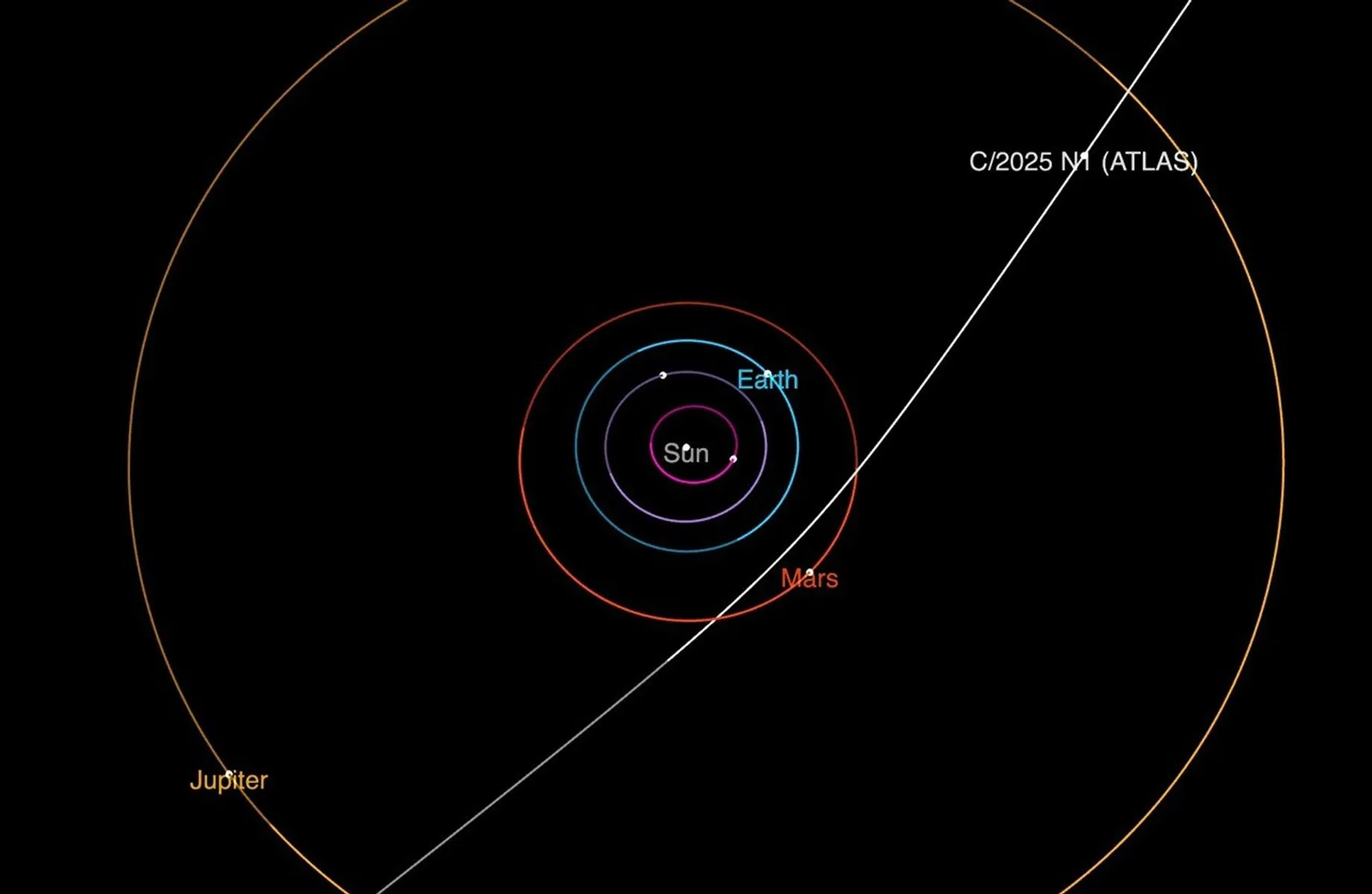
In the vast, seemingly infinite expanse of our universe, few celestial visitors generate as much curiosity and scientific interest as interstellar objects. Among these rare travelers, 3I/ATLAS stands out as a particularly remarkable case, captivating astronomers and astrophysicists across the globe. Its discovery not only challenged our understanding of celestial dynamics but also provided an unprecedented glimpse into materials and processes that originate outside our Solar System.
According to renowned physicist Prof. Brian Cox, 3I/ATLAS is best described as a visitor that journeyed across the cosmos for over 7.5 billion years before making its fleeting appearance in our cosmic neighborhood. The object’s journey across such a vast timescale underscores the complexity of interstellar matter and the processes that distribute these objects throughout the galaxy. This blog delves into the fascinating origins of 3I/ATLAS, its peculiar characteristics, and the scientific insights we’ve gained from studying this interstellar voyager.
The Origins of 3I/ATLAS: A Cosmic Wanderer
Tracing Its Stellar Past
While the precise birthplace of 3I/ATLAS remains elusive, scientists have constructed a probable narrative based on its trajectory, composition, and velocity. It is widely believed that this object originated in a distant star system, formed from the remnants of planetary formation or collisional debris. The analysis suggests that it was ejected from its home system during a period of planetary upheaval, possibly due to gravitational interactions with a massive planet or other celestial forces.
Its ejection from its parent system set it on an unaltered, hyperbolic trajectory—a path that differs from the bound orbits typical of objects formed within our solar neighborhood. Over billions of years, it traveled through interstellar space, an inert, icy, rocky visitor that remained largely unchanged since its ejection. The long trek through the galaxy exposed it to cosmic rays and interstellar dust, subtly modifying its surface and internal composition.
The 7.5 Billion Year Voyage
Joining researchers’ interest is the remarkable age of its journey—approximately 7.5 billion years. To put this into perspective, our Solar System formed approximately 4.6 billion years ago. This means that 3I/ATLAS has been wandering the galaxy well before the birth of our own Sun, potentially originating from a star system that existed in our galaxy long before the planets of Earth took shape.
Such a prolonged interstellar voyage makes 3I/ATLAS a unique cosmic artifact. It’s an ancient relic, embodying the primordial conditions of its era, traveling silently through the void until gravitational interactions brought it into our observational horizon.
The Peculiar Characteristics of 3I/ATLAS
Unusual Trajectory and Velocity
One of the defining features that distinguish 3I/ATLAS from Solar System objects is its hyperbolic trajectory, which indicates an origin outside the solar system. Its velocity as it approached Earth was approximately 94,000 mph (151,700 km/h). Such an extraordinary velocity reinforces the idea that it’s not gravitationally bound to our Sun but is instead passing through the Solar System for a relatively brief period.
Physical and Compositional Peculiarities
Recent observations, including those captured by Mars orbiters and terrestrial telescopes, have revealed intriguing aspects of 3I/ATLAS:
- Peculiar Shape: The object appears elongated or irregular rather than spherical, hinting at a potentially fractured or loosely bound structure.
- Signs of Water: Evidence suggests that it may contain water or ice, which could provide clues about the atmospheric and surface processes in its progenitor system.
- Surface Composition: Spectroscopic data point to surfaces rich in silicates and perhaps organic compounds, making it a subject of considerable interest regarding prebiotic chemistry.
Not an Alien Craft—Science’s Reassurance
Some popular theories speculated about the possibility of alien origins or artificial structures, but thorough scientific analysis—such as that highlighted in recent articles from BBC Sky at Night Magazine and WION) proves otherwise. The consensus indicates that the object’s characteristics align with natural origin processes, dominated by external forces rather than artificial design.
Scientific Discoveries and Observations
Close-up Imaging and Data Collection
The advent of remarkable space technology and surveillance allowed Mars orbiters and earth-based telescopes to capture detailed images of 3I/ATLAS during its passage through the Solar System. These images revealed its approximate length of about 400 meters—a size that, while small on cosmic scales, is significant enough to draw detailed analysis and propose hypotheses about its origin and internal structure.
The Search for Water and Organic Molecules
Among the most thrilling aspects of recent research are insights suggesting signs of water activity and complex organic molecules on its surface. These findings raise intriguing questions about whether such interstellar objects could naturally harbor the building blocks of life or at least chemical precursors essential for habitability and prebiotic chemistry.
Impact on Theories of Planetary System Formation
3I/ATLAS provides a rare glimpse into the materials and dynamics of planetary systems beyond our own. Its existence suggests that the formation and ejection of such objects are relatively common processes across the galaxy, broadening our understanding of planetary evolution, debris distribution, and potential planetary system diversity.
Misconceptions and Clarifications
While the idea of alien origins captured public imagination, scientific consensus remains firmly rooted in natural phenomena. Notably, articles from BBC Sky at Night Magazine emphasize that current models and data strongly support the natural origin theory, dismissing extraterrestrial or artificial hypotheses.
The Significance of 3I/ATLAS in Modern Astronomy
Discovering and analyzing interstellar objects like 3I/ATLAS expands our knowledge horizons. These objects serve as messengers from distant star systems, carrying the chemical fingerprints of their progenitors. Studying them can help answer fundamental questions:
- What is the composition of planetary building blocks in other star systems?
- How common is the ejection of debris into interstellar space?
- Could such objects have played a role in seeding life across planetary systems?
Moreover, each observation pushes the frontier of technological innovation, prompting the development of more advanced detection systems and international collaboration for interstellar exploration.
Conclusion: A Window into the Universe’s Past
In summarizing, 3I/ATLAS is more than just a passing celestial inhabitant—it’s a time capsule, a natural relic from an ancient star system, silently journeying through the galaxy for billions of years before briefly visiting our corner of space. Its characteristics and the scientific data collected have opened new avenues of research, providing profound insights into planetary formation, cosmic debris ejection, and the potential for life beyond our Solar System.
As our detection and analysis technologies improve, we anticipate discovering more such interstellar visitors, each offering a new perspective on the universe’s vast history and diversity.
For more updated news please keep visiting Hourly Prime News.