

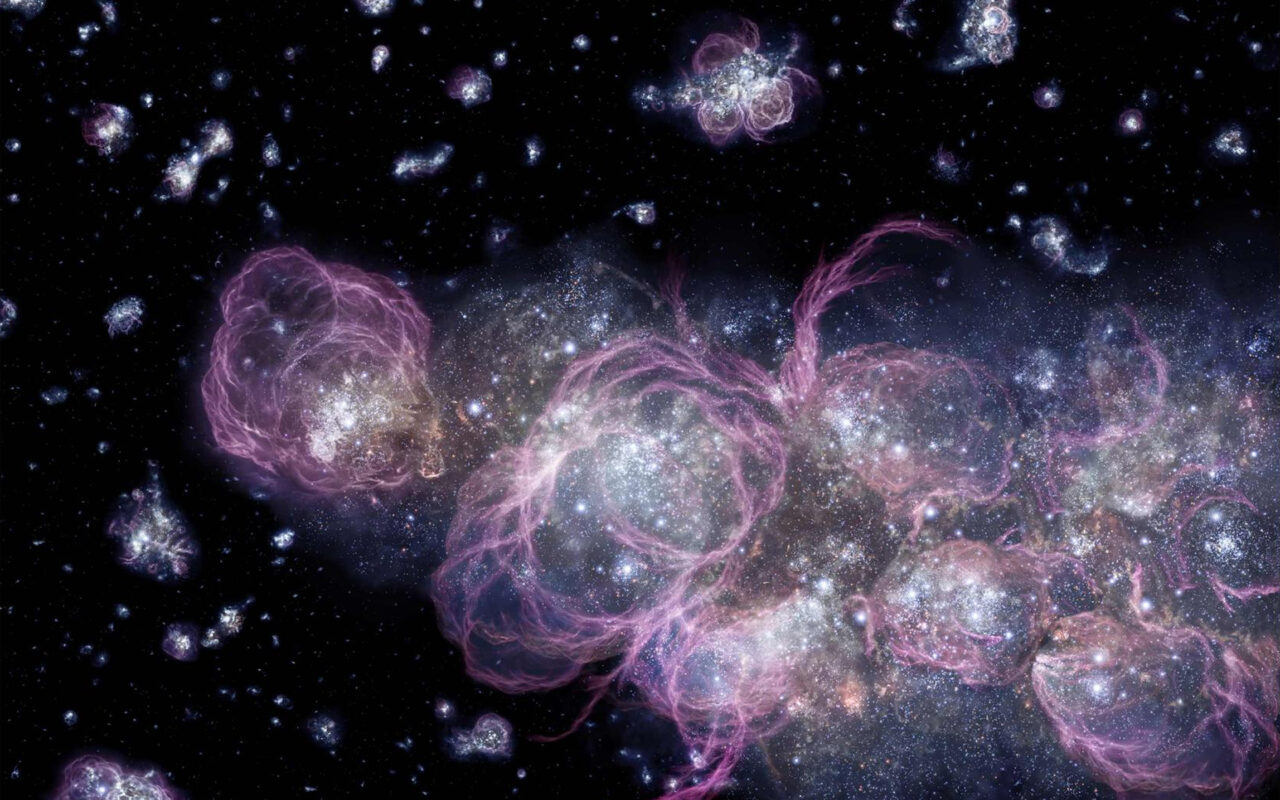
The quest to understand the origins of our universe has led scientists to make extraordinary advancements in recent years. Modern physics and cutting-edge technology are peeling back the cosmic veil, bringing us closer than ever to comprehending the universe’s earliest moments. These breakthroughs not only satisfy our innate curiosity but also push the boundaries of human knowledge, opening new chapters in cosmology. From recreating the conditions moments after the Big Bang to detecting particles that mirror the universe’s birth, each discovery illuminates the enigmatic infancy of our cosmos.
Recreating the First Moments of the Universe
Breakthroughs in Particle Physics and Collider Experiments
One of the most monumental strides in understanding the universe’s origin comes from high-energy collider experiments. Researchers have mounted efforts to recreate, in laboratory settings, the conditions present during the universe’s first fractions of a second. According to Breakthrough in Understanding the Very First Moments of the Universe (Hungary Today), scientists have managed to reproduce the primordial quark-gluon plasma, a state that existed just after the Big Bang. This plasma is a searing, dense soup of elementary particles, whose study offers invaluable insights into the universe’s initial conditions.
Through experiments involving colliding particles at near-light speeds, scientists have been able to generate temperatures and densities comparable to those moments after the universe’s inception. While these conditions were fleeting and challenging to analyze, innovations such as particle detectors and computational modeling enable physicists to decode this ancient cosmic environment.
The advent of ultra-sensitive detectors and high-capacity colliders
Among recent milestones is the successful utilization of colossal detectors capable of tracking thousands of particle collisions per second. As noted in New York’s ‘Big Bang Machine’ Passes Critical First Test (Gizmodo). This signifies a new era where human-made devices can simulate conditions mins before the universe’s birth, offering unprecedented laboratory insights into cosmic origins.
The Role of Particle Detectors and Colliders in Cosmology
Detectors such as the Large Hadron Collider (LHC) and other cutting-edge facilities are key to understanding the universe’s earliest moments. Their ability to observe ephemeral particles that appeared immediately after the Big Bang allows scientists to test theoretical models and refine our knowledge of fundamental physics. For instance, the recent success of detectors passing the “standard candle” test, as reported by New particle detector passes the “standard candle” test (MIT News), exemplifies how precision measurement tools are unlocking cosmic secrets.
Recreating the Universe: Theoretical and Experimental Advances
Collaborations and International Projects
Across the globe, major collaborations are working tirelessly to recreate and study the conditions of the early universe. For instance, American Collider Recreating Matter from the Beginning of Time (Popular Mechanics) highlights the impressive efforts to simulate the conditions that led to the formation of matter itself, bridging the gap between theoretical physics and experimental validation.
By recreating these extreme states of matter, scientists aim to understand the fundamental forces and particles that have shaped the cosmos. Their findings could answer lingering questions about the nature of dark matter, dark energy, and the initial symmetry-breaking events that set the universe in motion.
Implications of These Discoveries
The significance of these breakthroughs extends beyond academic curiosity. They influence cosmological models, inform our understanding of black holes, and even impact the development of new technological applications. As we learn more about the universe’s infancy, we gain perspective on its ultimate fate and our place within this vast cosmic tapestry.
Furthermore, these experiments foster international scientific collaboration, inspire technological innovations, and deepen our understanding of fundamental physics. They exemplify the extraordinary human endeavor to decode the universe’s earliest moments—an endeavor that continues to push the limits of science and imagination.
Conclusion
The recent advances in recreating and studying the universe’s first moments mark a new chapter in cosmology. From recreating quark-gluon plasma to developing sophisticated detectors and colliders, science is now capable of exploring conditions that existed mere fractions of a second after the Big Bang. These discoveries not only validate fundamental theories but also open new pathways for future research, promising to unravel even more secrets of the cosmos.
As technology continues to evolve, our understanding of the universe’s origins will grow deeper, fueling curiosity and discovery for generations to come. The universe’s earliest moments, once shrouded in mystery, are now coming into focus thanks to human ingenuity and relentless scientific pursuit.
For more updated news please keep visiting Hourly Prime News.