

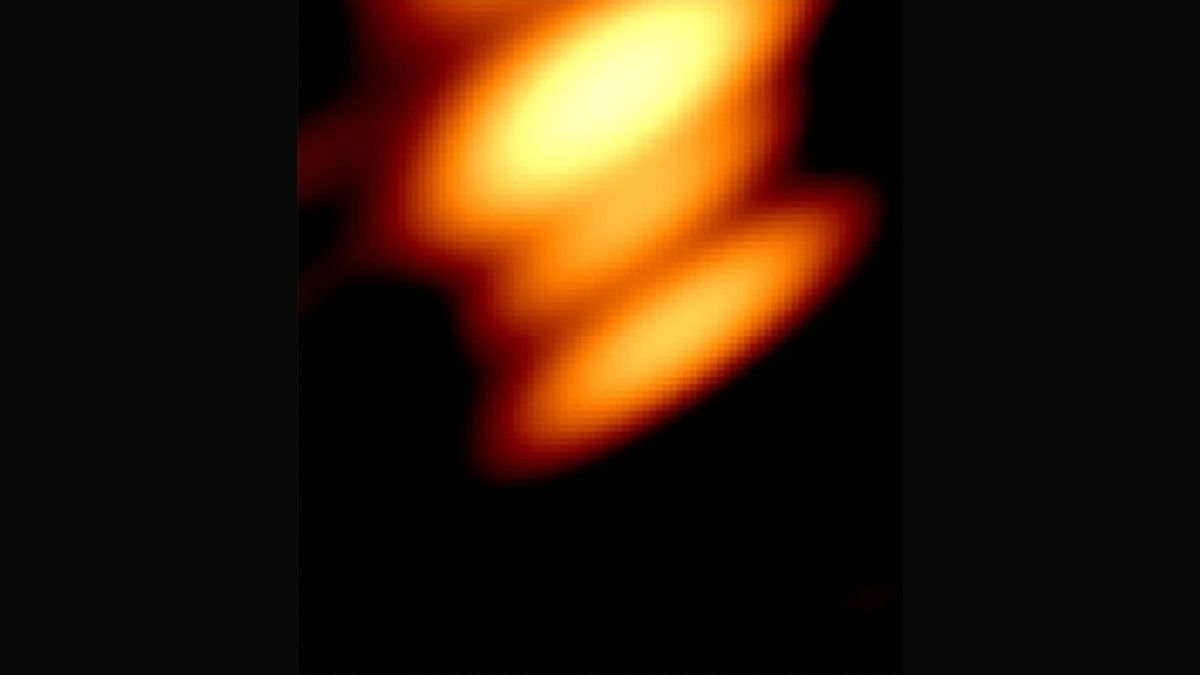
In a groundbreaking achievement, Finnish astronomers have visualized a cosmic phenomenon that has eluded scientists for decades: the first-ever direct image of two supermassive black holes orbiting each other. This historic discovery not only enhances our understanding of the universe’s most enigmatic entities but also opens new pathways for research into galaxy formation, gravitational dynamics, and the fundamental laws of physics.
The Significance of the Discovery
The cosmos is a vast and mysterious realm, home to countless celestial objects whose behaviors remain largely speculative due to observational challenges. Black holes, especially supermassive ones residing at the centers of galaxies, have been subjects of intense scientific curiosity. Typically, these behemoths are studied indirectly through their effects on their surroundings, such as accretion disks, jets, and gravitational influence on nearby stars.
Capturing a direct image of a single black hole’s event horizon was a monumental milestone earlier, exemplified by the Event Horizon Telescope’s 2019 image of M87*. Now, the ability to visualize a pair of black holes orbiting each other is an extraordinary progression. It provides concrete visual evidence for theoretical models predicting such systems and offers a rare glimpse into the dynamical interactions of black hole pairs, which are believed to be precursors to some of the most energetic phenomena in the universe, including gravitational wave emissions.
Details of the Observation
The team of Finnish astronomers utilized an advanced array of radio telescopes combined into a global network, harnessing the power of interferometry at an unprecedented scale. This synergy enabled them to obtain the highest resolution images ever achieved for such distant celestial objects, located approximately 3.2 billion light-years away. The observed black holes are part of a galaxy undergoing a merger, and their orbiting dance provides critical data for understanding the evolution of galactic cores in the universe.
The key imaging breakthrough was possible due to meticulous data collection and integration over months, coupled with sophisticated algorithms that reconstructed the otherwise invisible event horizons. The image reveals two dark regions—black holes—shaped by intense gravitational fields, encircled by luminous accretion disks, highlighting their intricate interactions.
Implications for Astrophysics and Cosmology
1. Confirming Theoretical Models
This direct imaging validates long-standing models of hierarchical galaxy mergers, where black hole pairs form during galactic collisions. It lends weight to prevailing theories that supermassive black holes often exist in pairs before eventually merging into even larger black holes, a process that emits detectable gravitational waves. Additionally, it offers a test bed for Einstein’s General Theory of Relativity under extreme gravitational conditions.
2. Enhancing Gravitational Wave Research
The detection of these black hole pairs provides crucial insights into the mechanisms producing gravitational waves—ripples in spacetime first confirmed by LIGO. By tracking the orbital parameters and masses of the black holes, scientists can better predict future mergers and refine gravitational wave astronomy models.
3. Understanding Galaxy Evolution
The findings shed light on how galaxies evolve over cosmic timescales. The dynamics of black hole pairs influence star formation rates, galactic core activity, and the distribution of mass. These interactions can trigger energetic phenomena, like quasars, thus shaping the cosmic environment.
Technical Challenges and Breakthroughs
Capturing images of such faint and distant events required overcoming significant obstacles. The primary challenge was achieving sufficient resolution to distinguish the black holes against the bright background of their host galaxies. This was made possible through Very Long Baseline Interferometry (VLBI), utilizing radio telescopes spread across continents to simulate a device the size of Earth.
The massive data volumes generated had to be processed with state-of-the-art computational techniques, including machine learning algorithms that enhanced image clarity and accuracy. The collaborative effort involved astronomers, physicists, data scientists, and engineers working in harmony, making this a true milestone in observational astronomy.
What the Future Holds
This groundbreaking observation paves the way for a new era of cosmic exploration. Future campaigns aim to pinpoint similar pairings across different galaxy types, measure their orbital parameters with higher precision, and monitor their evolution over time. The upcoming generation of radio telescopes, such as the Square Kilometre Array (SKA), promises even more detailed images, potentially capturing the moments preceding black hole mergers.
Furthermore, these visualizations will augment the growing field of multimessenger astronomy, integrating electromagnetic signals with gravitational wave detections for a holistic understanding of cosmic phenomena. As imaging techniques continue to refine, we may eventually witness the direct observation of black hole mergers and their role in the cosmic tapestry.
Global Impact and Scientific Collaboration
This discovery exemplifies the power of international scientific collaboration and technological innovation. It underscores Finland’s role in advancing astrophysics and highlights how coordinated efforts across nations can unlock the universe’s deepest secrets. The achievement also inspires young scientists and students worldwide to pursue careers in space science, emphasizing human curiosity and the relentless pursuit of knowledge.
Conclusion
The first image of two orbiting supermassive black holes marks a new chapter in our quest to understand the universe. It validates theories, enhances our grasp of cosmic evolution, and demonstrates the incredible capabilities of modern astronomical technology. As the field advances, humanity inches closer to unraveling the mysteries of black holes and the fundamental fabric of spacetime itself.
For more updated news please keep visiting Hourly Prime News.