

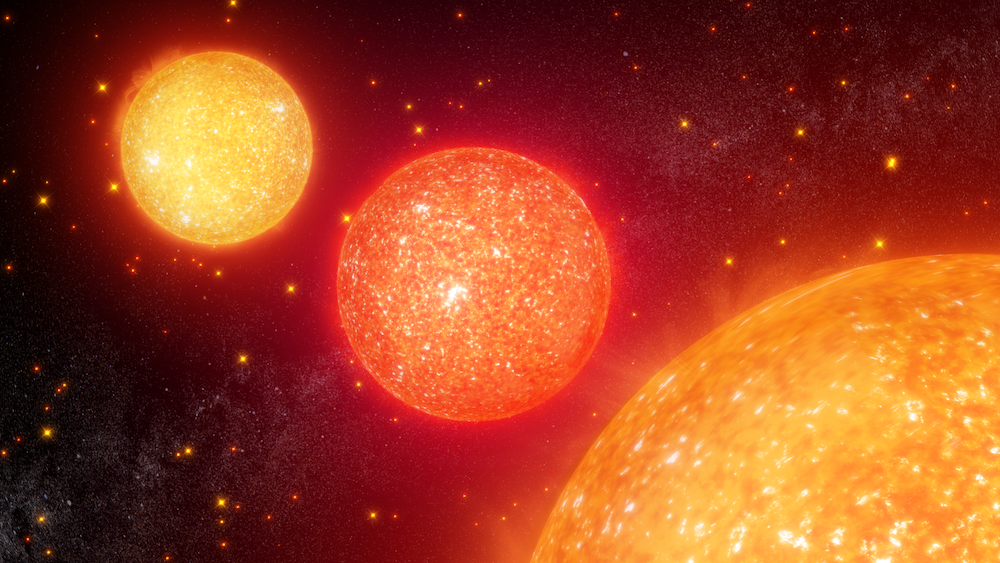
The universe is a dynamic and often unpredictable place, with stars undergoing dramatic transformations over billions of years. One such fascinating process involves stars nearing the end of their life cycle, particularly when they expand into red giants. Recent astronomical studies have shed light on a captivating and somewhat alarming phenomenon: dying stars consuming their own planets during this transformation. This discovery not only deepens our understanding of stellar evolution but also raises intriguing questions about the fate of planetary systems, including our own solar system.
Understanding Red Giants and Stellar Aging
A star’s life begins with nuclear fusion in its core, converting hydrogen into helium, and sustains itself through this process for millions to billions of years, depending on its mass. However, as stars exhaust their hydrogen fuel, they enter the ‘senior’ phase of their lifespan. This phase marks a significant change in their structure and size, leading to the formation of a red giant.
During this phase, the star’s outer layers expand enormously—sometimes hundreds of times its original size—causing the star to cool and turn a reddish hue. This expansion directly impacts any nearby planetary bodies. The increased size and luminosity can lead to intense gravitational and thermal interactions with planets that orbit too close, sometimes resulting in the destruction or consumption of these planets.
The Phenomenon of Stars Eating Their Planets
Actual Evidence from Recent Astronomical Research
According to recent findings reported by , astronomers have identified that some stars in the process of dying are actively devouring their nearby planets as they swell into red giants.
A prominent example of this phenomenon has been observed in stars that initially had planetary systems similar to our own. When the star’s core starts contracting and the outer layers expand, gravitational forces within the planetary system destabilize, and planets that once orbited at a safe distance can be pulled inward, eventually being engulfed by the expanding stellar atmosphere.
Mechanisms Behind Stellar Consumption of Planets
- Radial expansion: As a star becomes a red giant, its outer layers swell outward, often reaching distances where inner planets once safely orbited. This expansion can physically swallow planets, tearing them apart or absorbing them into the star.
- Mass transfer and accretion: In some cases, the star’s outer layers transfer mass to what remains of planets, leading to their gradual disintegration.
- Tidal interactions: The gravitational forces between a star and a close-in planet intensify as the star expands, creating tides that can strip planets of their atmospheres or pull them inward towards eventual engulfment.
The Future of Our Solar System and Other Planetary Systems
What Will Happen When Our Sun Turns Into a Red Giant?
Scientists predict that in about 5 billion years, the Sun will exhaust its hydrogen core fuel and expand into a red giant. During this transformation, it is expected to swallow Mercury, Venus, and possibly Earth, effectively ending any current life forms and restructuring the solar system as we know it.
This process will be gradual, spanning millions of years, offering a sort of cosmic warning of the inevitable changes that await our own planetary neighborhood. The Sun’s expansion will likely cause the orbits of the remaining planets to be destabilized, with some possibly being ejected from the solar system or consumed by the star’s swelling surface.
Impacts on Planetary Evolution and Habitability
The ongoing research illustrates that planetary systems are more vulnerable to stellar evolution than once believed. The fate of planets depends heavily on their initial placement relative to the star and the star’s mass. As stars age and transition into red giants, many planets could be obliterated or engulfed, drastically altering the architecture of the planetary system.
In some cases, planetary material itself can be accreted by the star, leading to observable anomalies—such as chemical signatures that suggest a star has absorbed planetary matter. This process not only affects the star’s composition but also signals the violent end stages of planetary systems.
Broader Implications: What This Means For Humanity and Our Search for Extraterrestrial Life
The discovery of stars consuming their planets has profound implications for our understanding of cosmic evolution and the potential longevity of life beyond Earth. If planetary systems are inherently unstable during late stellar phases, it influences the likelihood of finding stable habitable zones in aging star systems.
Furthermore, these findings assist scientists in interpreting astronomical data more accurately, particularly when analyzing white dwarfs and other remnants of ancient stellar systems. The presence of planetary debris around such stellar remnants can serve as evidence of planetary destruction caused by stellar expansion.
Conclusion: An Ever-Changing Universe Full of Wonders and Dangers
The recent revelations about dying stars consuming their planets as they morph into red giants remind us of the universe’s dynamic and sometimes dangerous nature. It also underscores the importance of understanding stellar evolution, not just for academic curiosity but for contemplating the ultimate fate of our own solar system.
As astronomical technology advances, we continue to uncover more about these processes, offering a glimpse into the violent and beautiful lifecycle of stars and their planetary companions. These insights deepen our appreciation for the delicate balance that sustains planetary systems and highlight the transient nature of even the most seemingly permanent celestial configurations.
References and Further Reading
- Astronomers Find Dying Stars Eating Their Planets as They Turn Red Giants
- Aging stars may be destroying their closest planets
- What will happen to Earth when the Sun dies?
- Is the world going to end? NASA supercomputer warns Earth could become lifeless soon
- Scientists issue chilling new prediction about when humanity could face its horrifying end
Understanding the end stages of stars not only enriches our cosmic knowledge but also underscores the transient nature of planetary systems. As we continue exploring distant worlds and phenomena, these insights remind us of the universe’s constant state of change, evolution, and eventual demise for many celestial bodies.
In conclusion, the phenomena of stars consuming their planets as they swell into red giants serve as a stark reminder of the universe’s vast timescales and dynamic processes. While such events might seem distant, they provide valuable perspectives on stellar life cycles, planetary stability, and ultimately, the future of Earth itself.
For more updated news please keep visiting Hourly Prime News.