

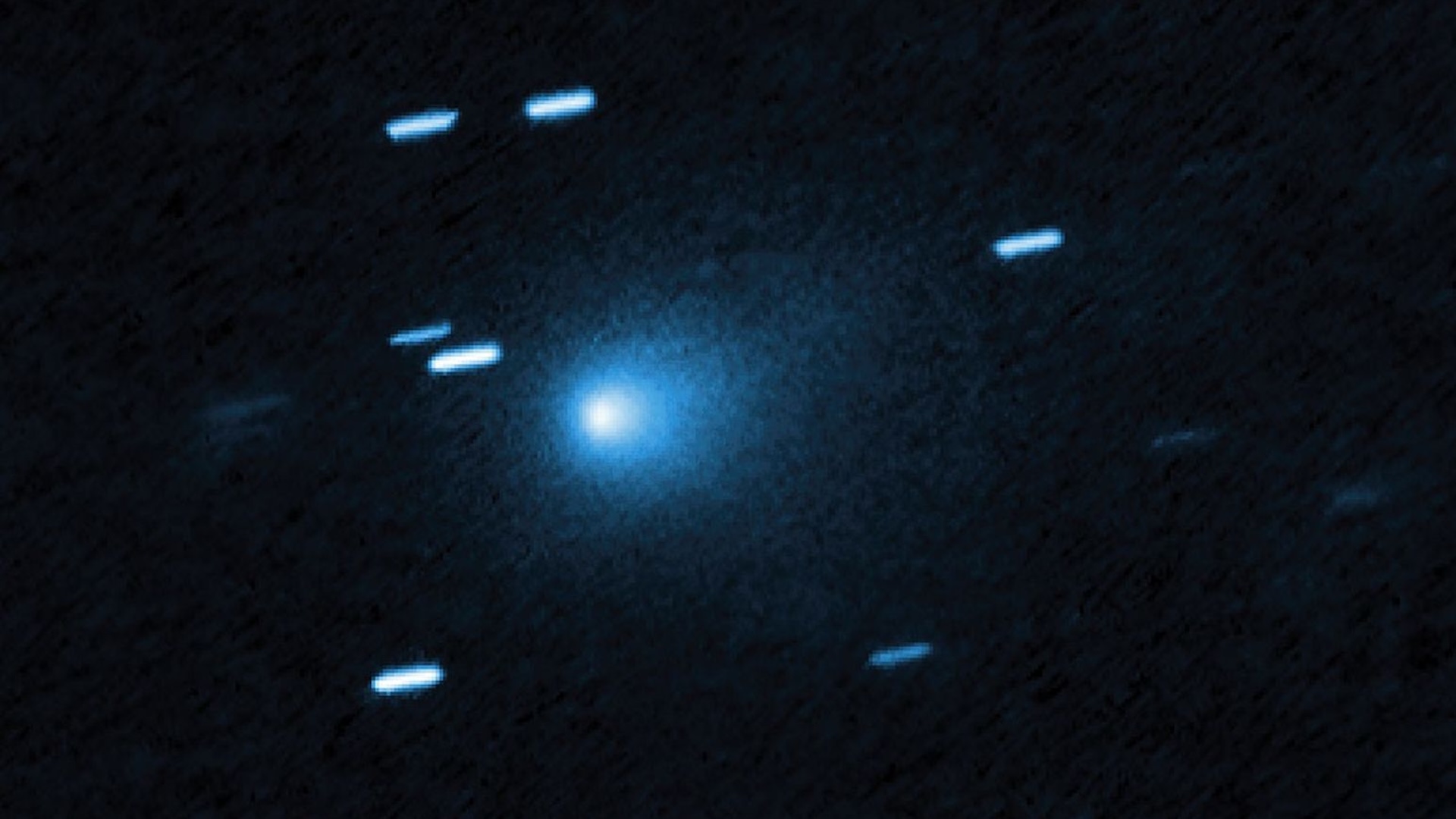
In recent weeks, the scientific community and space enthusiasts alike have been abuzz with speculation over the interstellar object known as 3I/ATLAS. Some sensational stories and viral rumors suggested that this celestial visitor might be an alien spacecraft or an artifact of extraterrestrial technology. This kind of speculation, fueled by the mysterious nature of interstellar objects, often ignites public imagination and spurs discussions about the possibility of intelligent life beyond Earth.
However, NASA, the premier space agency responsible for exploring our cosmos, has publicly addressed these rumors, reaffirming that 3I/ATLAS is a natural comet that originated outside our solar system. The agency has shared substantial evidence, including detailed images and scientific analyses, to clarify the object’s true nature and dispel any misconceptions about it being an alien artifact.
NASA’s Official Response and Evidence
Debunking the Alien Spacecraft Rumors
As reported by ANI News, NASA explicitly debunked the rumors claiming that 3I/ATLAS was an alien spacecraft or a manufactured object designed for extraterrestrial purposes. The agency emphasized that, after thorough analysis, the interstellar object exhibits features and behaviors consistent with known comets and asteroids.
NASA shared a series of images captured through multiple telescopes and spacecraft, depicting 3I/ATLAS in various wavelengths. These images have helped scientists analyze its composition, trajectory, and physical characteristics, all aligning with predictions for natural interstellar visitors.
The agency’s statement clarifies that, despite its unusual origin and rapid movement across our sky, the object shows no signs of artificial structure or technology. Instead, it exhibits cometary features such as a tail and a coma—gas and dust released as it approached the Sun—classic indicators of natural celestial bodies.
Visual Evidence: A Closer Look at 3I/ATLAS
Multiple Perspectives From NASA and Other Scientific Bodies
- View Interstellar Comet 3I/ATLAS Through NASA’s Multiple Lenses
- Orientation of the Plume Around 3I/ATLAS in the HiRISE Image
- ISRO Captures Rare Close-Up Of Fast-Moving 3I/ATLAS. See Pic
These images, obtained through advanced space telescopes like NASA’s Hubble and India’s ISRO, show the comet’s distinctive features—such as its tail, coma, and irregular shape—that are typical characteristics of natural interstellar bodies. The imagery also helps scientists track its trajectory and understand its composition, confirming that it is a naturally occurring object rather than an alien construct.
Scientific Analysis and Public Perception
What Do the Experts Say?
Leading astronomers and space scientists, including Harvard astronomer Avi Loeb, have analyzed the data surrounding 3I/ATLAS. While some researchers consider its origin and characteristics intriguing and unique, they uniformly agree that the object strongly aligns with the behavior and traits of comets originating from interstellar space.
In particular, Loeb’s analyses point to the object’s high velocity and hyperbolic orbit, features consistent with an interstellar origin. But he emphasizes that nothing in its physical appearance or movement indicates artificiality—simply a natural celestial visitor hailing from beyond our solar system.
This scientific perspective has been crucial in demystifying the object for the general public, helping to combat misinformation and avoid undue panic or speculation about extraterrestrial life.
The Significance of Distinguishing Natural from Artificial
While fascinating, the excitement surrounding interstellar objects like 3I/ATLAS must be tempered with scientific rigor. Misinterpreting natural phenomena as signs of alien technology can lead to misconceptions and unfounded fears. NASA’s transparent sharing of data, combined with expert analysis, exemplifies responsible communication and science-driven understanding.
It is important to recognize that the mysteries of space often resemble science fiction scenarios but are, upon closer inspection, phenomena rooted in natural physics and astronomy. The presence of an interstellar object like 3I/ATLAS opens new avenues for research, providing insights into the composition of other star systems, the dynamics of interstellar travel, and the early conditions of our galaxy.
The Broader Context and Future Missions
NASA, along with international space agencies, continues to monitor interstellar objects passing through our solar system. The study of such objects may eventually inform future missions aimed at understanding the origins of our solar system and even exploring the possibility of intercepting or capturing interstellar visitors.
In the future, more advanced telescopes and space probes may approach these distant bodies directly, providing high-resolution images and possibly even collecting samples for analysis, much like the successful missions to comets within our solar system such as Rosetta and Hayabusa2.
Such missions can unravel the mysteries surrounding the formation and evolution of planets and star systems, possibly shedding light on the origins of life itself in the universe.
Conclusion: Embracing Scientific Inquiry and Fact-Checking
In summary, despite the initial intrigue and sensational stories, NASA’s investigations have firmly established that 3I/ATLAS is a natural comet, not an alien spacecraft. The agency’s sharing of detailed images and scientific data has helped clarify the object’s true nature, reaffirming the importance of science and evidence-based explanations in understanding our universe.
As we continue to explore the cosmos, it is crucial to rely on verified data and credible analysis, avoiding unnecessary speculation that can hinder scientific progress. Space remains a vast and fascinating frontier, brimming with natural wonders waiting to be discovered—wonders that continually remind us of the boundless complexity and beauty of our universe.
For more updated news please keep visiting Hourly Prime News.