

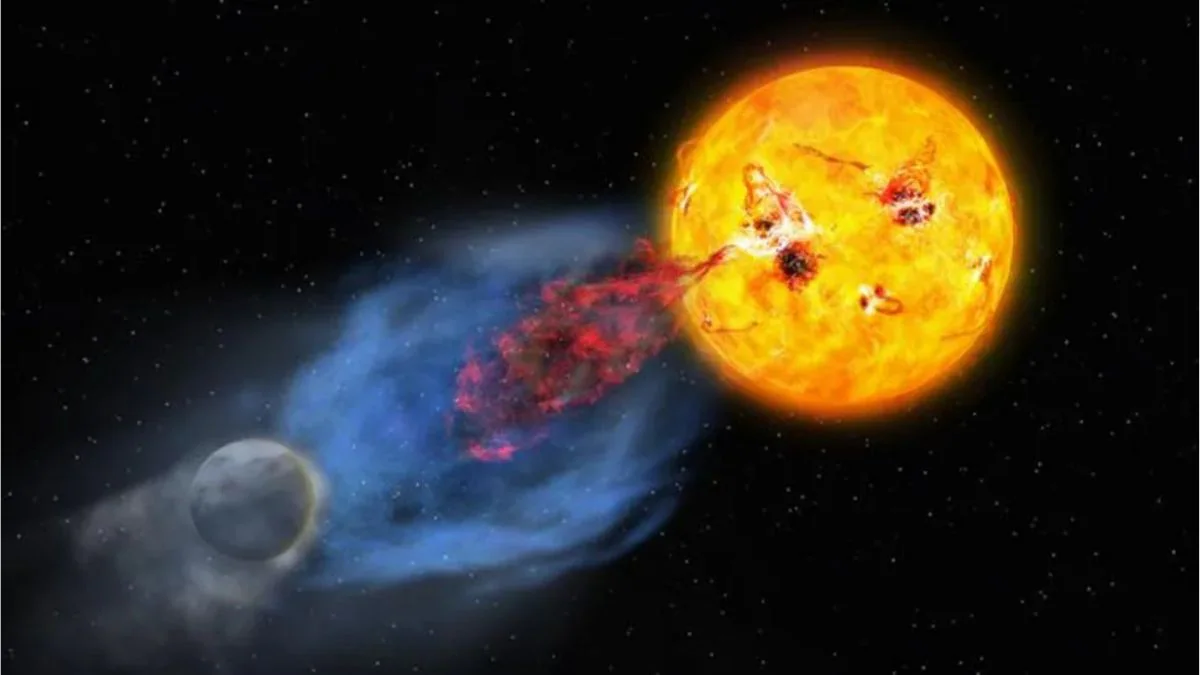
In a remarkable breakthrough, astronomers utilizing advanced radio telescopes have detected a colossal eruption from a distant star—often termed a *monster star*—whose ferocity rivals some of the most energetic phenomena observed in our galaxy. This discovery not only pushes the boundaries of our understanding of stellar behavior but also raises alarms about the possible consequences such eruptions could have on their neighboring planetary systems.
Radio telescopes have long been pivotal tools in space exploration, capable of peering into the depths of the universe and capturing signals from phenomena invisible to optical telescopes. These instruments detect radio waves emitted by celestial bodies, providing invaluable insights into events such as pulsar emissions, gamma-ray bursts, and, as recently observed, massive stellar eruptions. The recent detection has underscored the power of radio observations in unraveling the universe’s most violent and energetic episodes.
The Magnitude of the Detected Eruption
The star in question exhibited an eruption so formidable that scientists estimate its energy output was sufficient to strip atmospheres from planets in its vicinity. This eruption’s intensity challenges our previous notions about stellar stability, especially in stars that are ostensibly similar to our Sun but on a far more extreme scale.
Details from the Observation
- The Eruption’s Strength: The radio signals recorded indicate a storm of unprecedented magnitude, with emissions intensifying rapidly followed by a prolonged release of energy.
- Impact on Nearby Planets: The sheer scale of the eruption hints at potentially devastating effects on planets orbiting this star, including the possibility of atmospheric erosion, increased radiation levels, and possibly rendering planets uninhabitable.
- Comparison with Solar Events: While our Sun experiences solar flares and coronal mass ejections, this event dwarfs those phenomena, classifying it as a *monster eruption*.
Such phenomena are rare but are not unprecedented in the universe’s vast expanse. The recent detection provides critical data to understand the life cycles of massive stars and the dangers they pose—not just to their own systems but also to any potential life forms or technological infrastructure in their planetary neighborhoods.
Implications for Planetary Habitability
The observation of such a violent stellar eruption raises profound questions about the habitability of planets in hostile star environments. If a star’s eruptions periodically unleash energy comparable to the recent event, planets orbiting these stars might be subjected to intense radiation blasts capable of destroying their atmospheres. This has direct implications for the search for extraterrestrial life and understanding the factors that make some planets viable for life while others become desolate wastelands.
Potential Dangers to Nearby Planets
- Atmospheric Stripping: The energy from massive eruptions can physically blow away atmospheres, leaving planets exposed to harmful space radiation.
- Radiation Exposure: These events can significantly increase stellar radiation levels, sterilizing surfaces and possibly preventing the emergence or sustainability of life.
- Magnetic Field Disruption: Sudden outbursts may disrupt planetary magnetic fields, which serve as protective shields against cosmic radiation.
Such destructive potential emphasizes the importance of monitoring stellar activity, especially for stars hosting planets within habitable zones. Understanding the frequency and magnitude of these eruptions is critical in assessing whether certain exoplanets can support life in the long term.
The Broader Astronomical Context
This recent discovery joins a growing body of evidence suggesting that stellar activity can be far more chaotic and energetic than previously believed. In addition to this explosion, astronomers have documented stellar coronal mass ejections (CMEs) and other violent phenomena like star storms—some of which have been observed to resemble our solar storms, but on an amplified scale.
Coronal Mass Ejections and Their Effects
- Radio Bursts from CMEs: As reported by studies in Nature, radio bursts emitted during stellar CMEs are indicators of intense magnetic activity and mass expulsions that can have profound effects on the star’s planetary system.
- Implications for Space Weather: Just as solar storms influence space weather near Earth, stellar CMEs can unleash bursts of radiation that threaten the integrity of planetary atmospheres and technological assets.
The First Observations of Stellar Storms Beyond the Sun
While our Sun’s activity has been studied extensively, recent observations mark a pioneering step in understanding how other stars behave. In particular, some of the most significant findings include:
- Detection of Monster Events: Astronomical instruments have documented eruptions on distant stars that are significantly larger than any solar event observed to date.
- Outside Solar System Explosions: Telescopes flying beyond Earth’s vicinity, capable of capturing such cosmic phenomena, have confirmed that stellar explosions are common and can sometimes even be more destructive than solar counterparts.
- Precursor Signs of Stellar Activity: These detections serve as early warnings, enabling scientists to create models predicting future stellar behavior.
The Significance of These Discoveries for Future Research
This breakthrough provides a new framework for understanding the lifecycle and activity of massive stars. It underscores the importance of multi-wavelength observations, combining radio, optical, and X-ray data, to develop a comprehensive picture of stellar eruptions and their aftermath.
Moreover, by studying these extraordinary phenomena, scientists can better estimate the potential hazards for planets residing in such volatile stellar systems. This knowledge is crucial, especially as the search for life beyond our solar system intensifies, prompting a reassessment of where habitable worlds might survive in the cosmic neighborhood.
Conclusion: A Universe of Explosive Phenomena
The detection of this *monster star eruption* demonstrates that the universe is incredibly dynamic and often violent. Radio telescopes have opened a window into these energetic outbursts, revealing details that can reshape our understanding of stellar phenomena and their consequences for surrounding planets.
As technology advances, monitoring stellar activity will become even more refined, helping us predict cosmic weather patterns and assess the long-term habitability of exoplanets. These insights are vital not only for astrophysics but also for planetary protection and the ongoing quest to find life elsewhere in the universe.
With each discovery, we gain a deeper appreciation of the universe’s complexity and power, reminding us of the delicate balance required for life to exist in the cosmos.
For more updated news please keep visiting Hourly Prime News.