

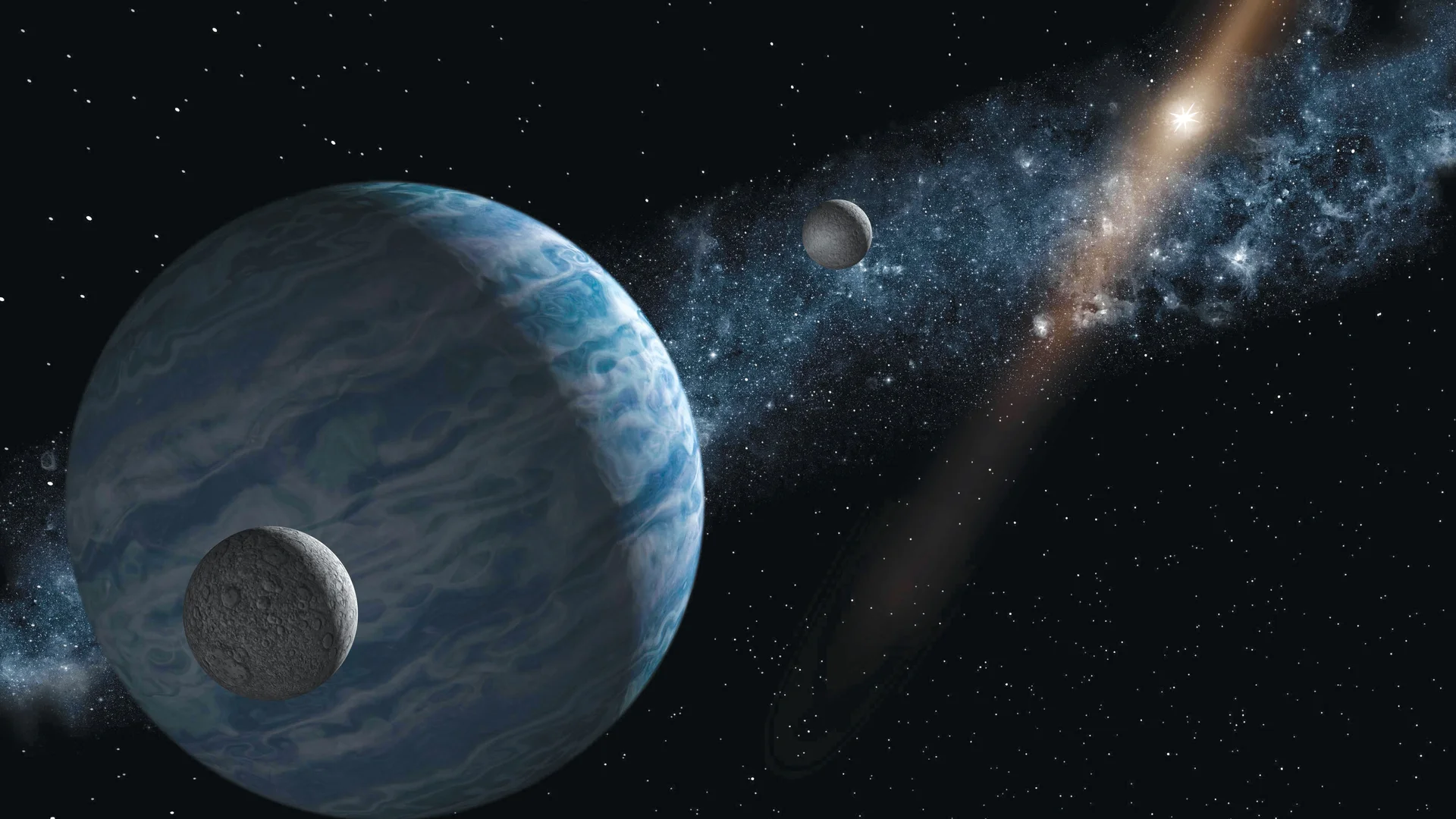
For decades, astronomers and space enthusiasts have speculated about the existence of a massive, unseen planet lurking on the outskirts of our solar system. Traditionally, the focus has been on Planet Nine, a hypothetical celestial body believed to orbit far beyond Neptune, influencing the orbital patterns of trans-Neptunian objects (TNOs). However, recent developments and intriguing theories suggest that there might be an even more tantalizing discovery — a hidden Earth-sized planet that could be *much closer* to us than Planet Nine.
This mysterious body is often referred to in scientific circles as ‘Planet Y’. Recent hypotheses posit that such a planet isn’t just a distant, speculative object but might be a tangible, yet-to-be-detected component of our solar system. The idea ignites excitement because a planet of Earth’s size orbiting closer to the inner solar system could redefine our understanding of planetary formation and the architecture of our celestial neighborhood.
The ‘Planet Y’ Theory Explained
The ‘Planet Y’ theory is based on a combination of astronomical observations, orbital dynamics analysis, and computer simulations. Researchers have noticed anomalies in the trajectories of objects in the Kuiper Belt and beyond, which don’t align with the gravitational influences known from the eight recognized planets. These discrepancies hint at the gravitational pull of an undiscovered massive object—possibly a planet.
According to some scientists, ‘Planet Y’ could be an Earth-sized planet, orbiting within a few hundred astronomical units — significantly closer than the estimated distance of Planet Nine, which is believed to be nearly 400-800 AU from the Sun. The proximity makes this hypothetical planet an intriguing candidate for future direct observation, as its effects on nearby objects might be more detectable than previously assumed.
Why the Closer Proximity Matters
Finding a planet closer to Earth has profound implications:
- Feasibility of Direct Observation: A nearer planet increases the chances that advanced telescopes and upcoming space missions could directly detect it in the near future, rather than relying solely on indirect gravitational effects.
- Revolutionizes Solar System Models: Its existence would demand a revision of current models of planetary formation and migration, challenging long-held theories that all planets formed in a specific region.
- Potential for Future Exploration: A closer Earth-sized body could become a target for robotic missions or even future manned missions, dramatically expanding our reach beyond the familiar planetary family.
Recent Advances Bolstering the ‘Planet Y’ Hypothesis
Over the past few years, several key discoveries have added credence to the idea that our solar system is more complex and populated than we previously believed:
- NASA’s Long-Masked Object: After four decades of investigation, NASA formally confirmed the presence of a long-masked object inside the solar system. Though this object was initially thought to be an asteroid or a distant planet, recent analysis suggests it could be part of a larger, unseen planetary body influencing the solar system’s dynamics (ecoportal.net).
- Fresh Clues of a Hidden Object: Astronomers have been gathering evidence that supports the existence of a long-suspected ‘Planet Y.’ These clues include unusual orbital patterns of trans-Neptunian objects and astrophysical anomalies that seem to point toward a massive, yet unseen, celestial body. Such discoveries reinforce the possibility that a significant, Earth-sized planet is quietly orbiting somewhere within our solar system’s distant boundary (CNN).
- Implications from Orbital Anomalies: Observations of orbital deviations among known planets and TNOs have fueled speculation about an unseen massive planet lurking in the outer reaches, further fueling the ‘Planet Y’ hypothesis.
Scientific Perspectives and Challenges
While the ‘Planet Y’ hypothesis is compelling, it faces several scientific and observational challenges:
- Detection Difficulties: Due to its potential location in the distant or obscured parts of the solar system, detecting such a planet requires highly sensitive instruments, possibly beyond current technological capabilities.
- Orbital Uncertainty: The precise orbit, size, and mass of this hypothetical planet remain speculative. This uncertainty demands more comprehensive data and meticulous analysis.
- Alternative Explanations: Some astronomers argue that anomalies could be attributed to other factors like passing stars, cosmic dust, or observational biases, rather than a new planet.
Implications for Space Exploration and Our Understanding of the Cosmos
Discovering an Earth-sized planet within a relatively close range of our solar system could have a transformative impact:
- Mission Opportunities: It could pave the way for future space missions dedicated to exploring this hidden world, unlocking secrets about planetary formation and the history of our solar system.
- Enhanced Solar System Models: Astronomers would need to revisit and refine models, possibly leading to new insights into the dynamical evolution of planetary orbits.
- Understanding Hidden Worlds: The study of such planets could broaden our perspective on planetary systems elsewhere in the galaxy, enhancing the search for habitable worlds beyond Earth.
Conclusion: The Future of Solar System Exploration
The idea that a hidden, Earth-sized planet could be orbiting nearer than our previously envisioned cosmic frontiers invites us to consider a future where our understanding of the solar system is still expanding. The ‘Planet Y’ theory combines observational evidence, astronomical anomalies, and innovative scientific hypotheses to challenge our assumptions and ignite curiosity about what lies beyond the known planets.
As technology advances and our observational techniques become more refined, we may soon find definitive evidence for or against the existence of this intriguing planetary body. Whether it’s a distant hypothesis or an imminent discovery, the pursuit to uncover hidden worlds in our solar system exemplifies the unending human quest to explore the cosmos.
For more updated news please keep visiting Hourly Prime News.