

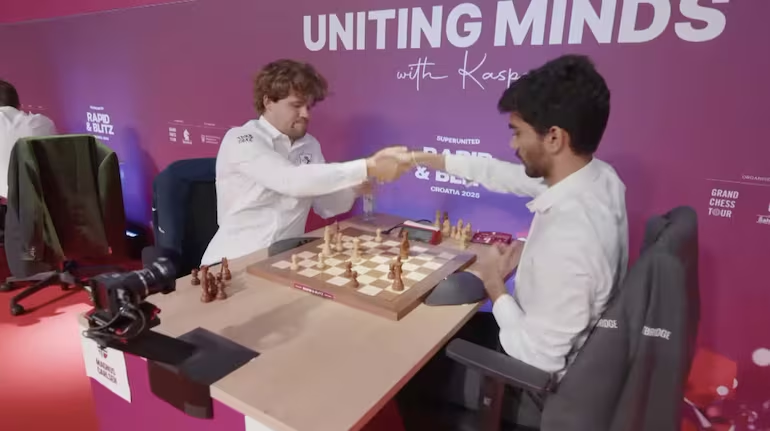
Introduction: A Clash of Titans Sparks Controversy and Triumph
The world of chess recently witnessed an electrifying confrontation between two prodigies—**Magnus Carlsen**, the reigning world champion, and **D Gukesh**, one of India’s most promising young grandmasters. Their encounter has ignited discussions not only about talent and strategy but also about decompression, character, and the volatile nature of competitive chess. Central to this clash was Carlsen’s sharp turn from dismissing Gukesh’s gameplay as “rubbish” to ultimately securing a convincing victory in the blitz section, which served as a fitting revenge and a statement of dominance.
This article delves into the intricate details of this encounter, analyzing the controversial comments, the shifting momentum, and the broader implications for both players and the chess community worldwide.
The Initial Disdain: ‘The game was rubbish’
The controversy started when Magnus Carlsen publicly criticized Gukesh’s performance, asserting matter-of-factly that “the game was rubbish.” This initial salvo was not merely a comment on a single game but reflected underlying tensions often present at the highest levels of chess. Carlsen, known for his psychological acuity and ability to read opponents’ mental states, implied that Gukesh’s moves lacked finesse and strategic depth, perhaps also highlighting the young grandmaster’s mistakes or oversights during their initial encounter.
Gukesh’s rising prominence had been a cause of concern for many veteran players, and his aggressive style and fearless approach drew both admiration and skepticism. The critique from Carlsen was interpreted by many as a test of Gukesh’s resilience—a challenge to see if he could rise above the negativity and prove his worth.
**However, what might have appeared as a blatant insult was also perceived as a strategic move—testing Gukesh’s mental fortitude and readiness to confront criticism at the highest level.**
The initial remarks sparked widespread debate on social media and across chess circles, with some critics arguing that Carlsen’s tone was inappropriate, while others viewed it as a display of confidence and assertiveness that seasoned champions often exhibit to unsettle their opponents.
Gukesh’s Response and the Shift in Momentum
Following this provocative remark, Gukesh responded in a composed manner, focusing on his game and maintaining his focus. Despite the setback of the initial comment, the Indian prodigy demonstrated admirable resilience, refusing to be rattled. In subsequent encounters, Gukesh continued to display his aggressive style but also gained confidence, which reflected in his gameplay.
However, the real turning point arrived during the blitz section of the tournament, where Carlsen sought to reassert his dominance. In a surprising turn, Carlsen **delivered a decisive victory against Gukesh**, placing him ahead in the overall standings. This victory was thoroughly analyzed for its strategic brilliance, highlighting Carlsen’s deep understanding of rapid and blitz formats.
> **According to the Hindustan Times**, Carlsen’s win was not just about the score but also about the psychological victory, showing that he could switch gears swiftly and outplay a formidable opponent when it mattered most.
It was here that Carlsen’s **revenge** was complete—his easy and confident win served as a powerful message: that his dominance in the chess world remains unchallenged when pressed.
Carlsen’s Masterclass in Blitz Chess
The blitz game showcased Carlsen’s adaptability, quick thinking, and psychological warfare. His moves were marked by clarity and precision, exploiting the smallest inaccuracies by Gukesh. Notably, Carlsen’s comment post-match—referencing his victory as “playing old-man chess”—underscored his strategic depth and experience that outstripped his younger opponent.
For Gukesh, these losses were a harsh but necessary reality check. Despite his rising star status, the encounter with Carlsen underscored the importance of refining rapid and blitz skills, as well as mental resilience under pressure.
**Chess experts and former champions like Garry Kasparov weighed in on the matchup**, emphasizing that Gukesh still has much to learn, especially in high-stakes, fast-paced scenarios. Kasparov’s critique was straightforward: **”Gukesh is not yet ready for blitz at the highest level.”** His statement, while blunt, served as a reminder of the gap that still exists between Gukesh and the sport’s elite—yet, it also provided motivation for the young star to improve.
Analysis of the Critical Moments
The key moments in the blitz game revealed Carlsen’s deep understanding of opponent tendencies and his ability to both capitalize on mistakes and manipulate the pace of the game. Throughout, Carlsen exhibited calmness, patience, and tactical precision—traits that have earned him his reputation as a formidable chess innovator.
Gukesh, on the other hand, faced difficulty in maintaining composure when under pressure, which is often the downfall of young candidates competing at the highest level. Kasparov’s comments echoed this sentiment, emphasizing that experience is critical in blitz formats, which require split-second decision-making.
This encounter exemplified what many in the chess community have long suspected: **that the battle for supremacy is as much psychological as it is strategic**. Carlsen’s mastery of these nuances was on full display, reinforcing his position at the top of the chess hierarchy.
The Broader Implications for the Chess World
This dramatic face-off between Magnus Carlsen and Gukesh has several implications:
– **For Gukesh**: The defeat is a wake-up call, emphasizing the need to sharpen rapid and blitz skills and develop mental resilience under pressure. His attitude throughout the tournament showcased maturity, and many analysts believe this experience will serve as a catalyst for future growth.
– **For Carlsen**: The victory reaffirmed his dominance, while his outspoken demeanor continues to shape the narrative of confidence and psychological toughness that defines his career.
– **For Chess Enthusiasts**: The match highlighted the evolving landscape of competitive chess, where youth innovation meets experience and strategic mastery. The interactions between these two players symbolize the ongoing generational transition—yet, with the established champions still holding sway.
– **In the chess community**, debates around sportsmanship, respect, and mental toughness have intensified. Critics argue whether Carlsen’s blunt commentary was necessary or a calculated psychological tactic, while supporters view it as part of his competitive edge.
Conclusion: An Epic Chapter in Chess History
This matchup between Magnus Carlsen and Gukesh was more than just a game; it was a captivating chapter that showcased the sport’s intensity, psychological drama, and the relentless pursuit of excellence. Carlsen’s initial dismissive comment, followed by his calculated and cool-headed victory, painted a picture of a champion in complete control, yet also human enough to acknowledge the resilience needed by newer entrants.
Gukesh’s performance, despite the loss, demonstrated the rising tide of new talent eager to challenge established legends. The chess world watches with anticipation as these players continue their journey, learning, evolving, and pushing the limits of their strategic and mental capacities.
In the end, this encounter reaffirmed that in chess, as in life, resilience and adaptability are key. Carlsen’s revenge in the blitz section was a testament to his seasoned mastery, while Gukesh’s response hinted at future battles yet to come—all promising a bright future for the game.
For more updated news please keep visiting Hourly Prime News.