

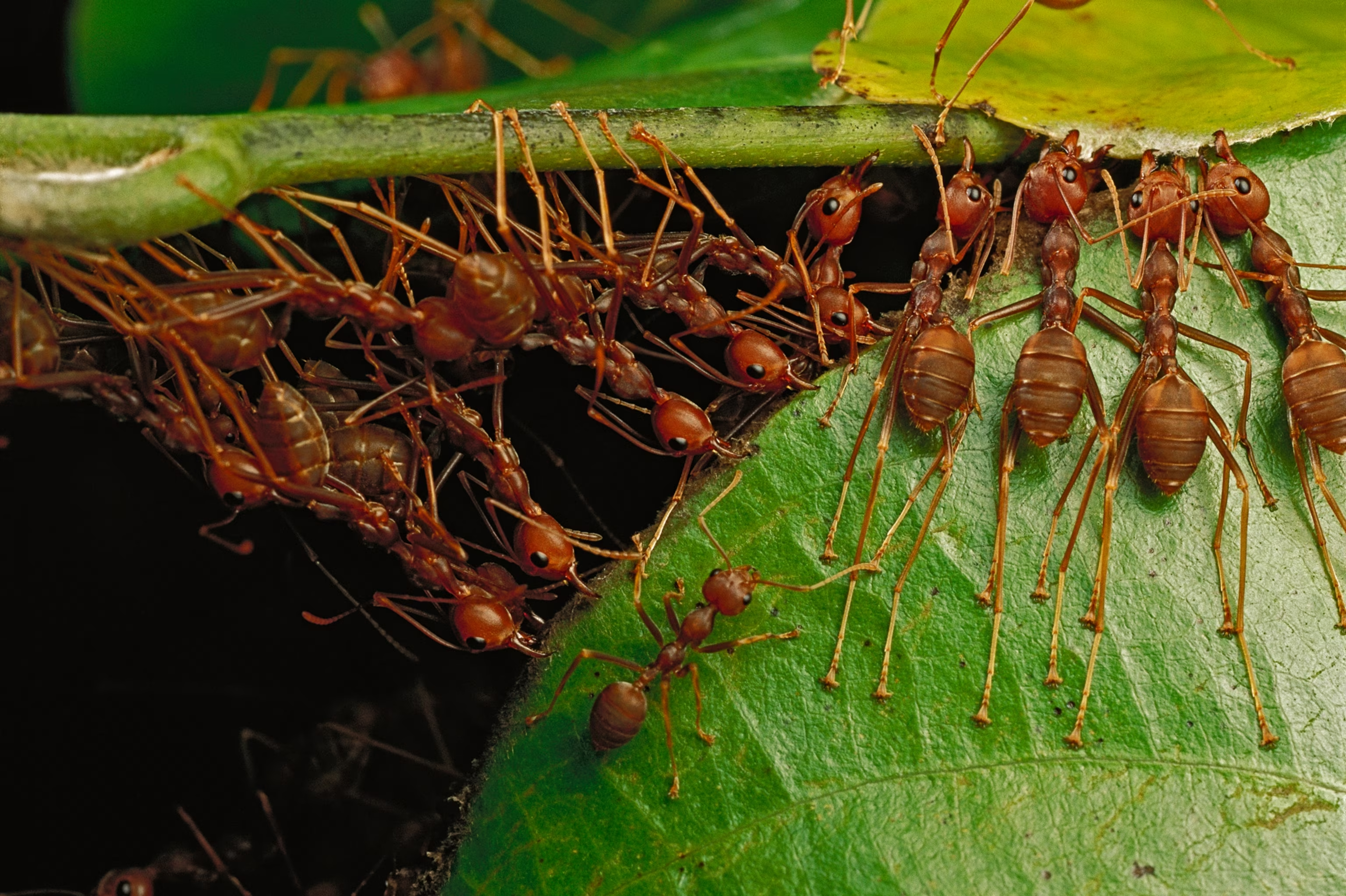
The natural world continuously surprises us with its complexity and adaptations, pushing the boundaries of our understanding of biological relationships. Recent groundbreaking discoveries involving ant species, specifically the behaviors and reproductive strategies centered around a single queen ant potentially giving rise to multiple species, have begun to redefine what “family” truly means in the context of nature. These revelations not only fascinate scientists but also challenge longstanding perceptions of species boundaries and kinship. In this blog, we delve deep into these findings, exploring how a single queen ant can influence multiple species, the mechanisms behind such phenomena, and their implications on our broader understanding of evolution and biological kinship.
Key Discoveries in Ant Reproduction and Family Structures
The Phenomenon of a Single Queen Supporting Multiple Species
Recent research has uncovered instances where a solitary queen ant appears to have a role in supporting or producing offspring of two different species. This goes against the conventional understanding that reproductive isolation is critical for maintaining distinct species barriers. For example, a study highlighted in theweek.in describes how some queen ants are involved in complex reproductive behaviors, including obligate cross-species cloning, leading to offspring that blur the lines typically drawn between species. This discovery in ant microbiology and behavior points toward a dynamic, and sometimes unpredictable, evolutionary landscape where “family” extends beyond genetic boundaries.
Obligate Cross-species Cloning: A Breakthrough in Evolutionary Biology
Obligate cross-species cloning, detailed in Nature, underscores a reproductive strategy whereby a mother ant produces offspring that are genetically distinct yet linked through complex biological mechanisms. This phenomenon, seen in some ant species, involves a form of “molecular cloning,” where genetic material from a mother can produce diverse offspring, possibly of different species. This undermines classical genetic inheritance theories and warrants a rethinking of kinship models in social insects.
The Implications of Such Discoveries on Our Understanding of Family and Species
Expanding the Concept of Family in Nature
Traditionally, the term “family” in biological terms has been associated with genetic kinship—sharing DNA across generations. However, these novel findings suggest that in some species, relationships may extend beyond genetic ties, involving complex reproductive strategies that produce hybrid or multi-species offspring. The discovery that a single queen ant can sustain or even produce offspring spanning multiple species fundamentally questions the rigidity of biological classifications and opens new avenues for understanding social structures in nature.
Species Boundaries and Evolutionary Flexibility
Such reproductive behaviors, including the phenomenon of one queen supporting or producing offspring from two different species, indicate a level of evolutionary flexibility that was previously underestimated. These strategies enable species to adapt rapidly to changing environments, diversify their gene pools, and potentially develop novel traits. For instance, as discussed in the potential of cloning and hybridization in ant species, new pathways are emerging for hybrid vigor and adaptive evolution.
The Impact on Broader Evolutionary and Ecological Contexts
Revisiting Evolutionary Theories
The discoveries of such complex reproductive behaviors and multi-species offspring in ants challenge classical evolutionary models that emphasize speciation via reproductive barriers. Instead, these ants demonstrate that hybridization, cloning, and gene flow between species can be part of natural strategies for survival and adaptation. These findings align with observations from theories of reticulate evolution and genetic exchange.
Environmental Adaptability and Future Conservation Strategies
Understanding these reproductive strategies enhances our grasp of how species adapt to environmental pressures. If reproductive processes can cross species boundaries, then conservation efforts might need to shift focus from solely preserving species to maintaining habitats and ecological networks that support such unique evolutionary phenomena. The ability of a single queen to influence multiple species extends the significance of ecological stability and resilience, especially in fragile ecosystems.
Conclusion: Redefining the Biological “Family”
The discovery of a single queen ant’s capacity to support or produce offspring spanning multiple species is a milestone in understanding biological diversity. It challenges the traditional views of family rooted in strict genetic kinship and highlights the fluidity of species boundaries under natural mechanisms like hybridization and cloning. As scientists continue to explore these phenomena, our perception of evolution, kinship, and the very fabric of life on Earth will likely evolve as well.
This landmark research underscores that in the natural world, “family” is a dynamic concept—more intricate, flexible, and interconnected than previously imagined. It reminds us that nature often defies human-defined categories, revealing instead a complex tapestry of relationships that push the boundaries of science and philosophy alike.
For more updated news please keep visiting Hourly Prime News.