

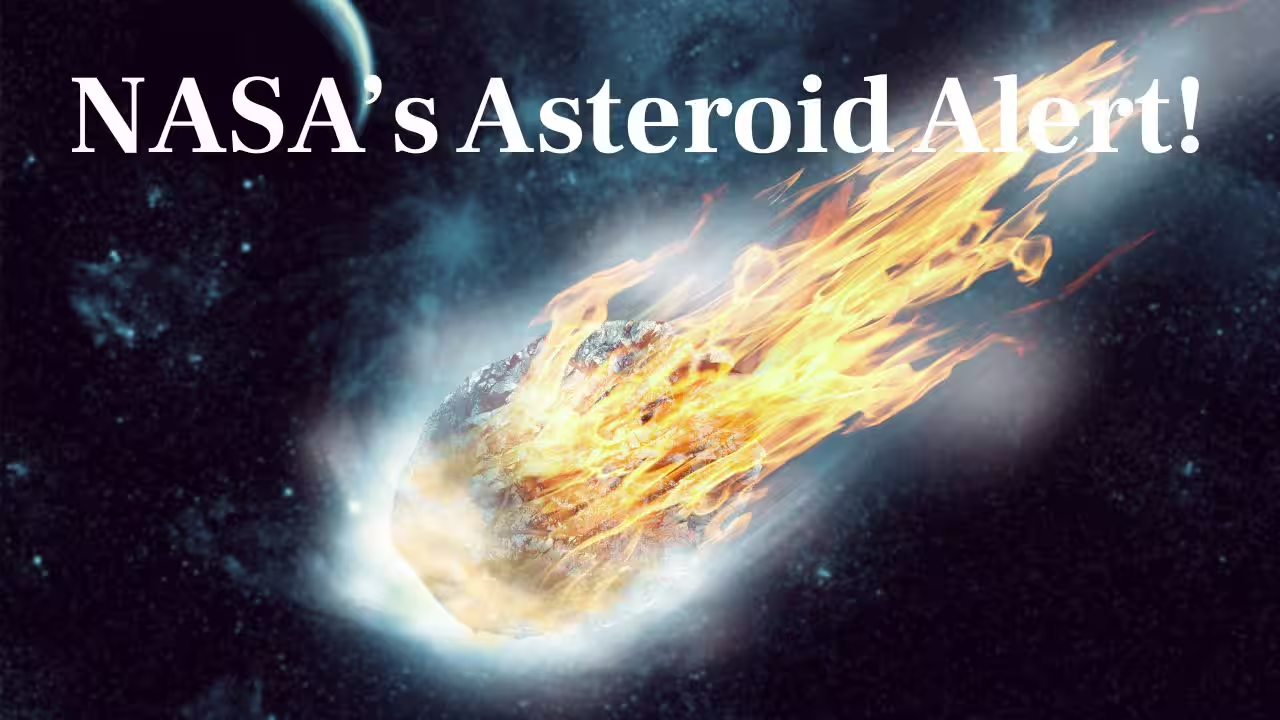
In an unprecedented announcement, NASA has issued a stark warning about a significant celestial visitor heading towards Earth. This isn’t just any space rock; it’s a 140-foot asteroid barreling through space at a dizzying speed of 41,157 miles per hour. While in the vastness of space, such objects are often unnoticed, the proximity of this asteroid has raised alarm bells among scientists and space agencies worldwide. The upcoming approach scheduled for tomorrow has prompted enhanced scrutiny and widespread concern regarding potential risks.
Details of the Approaching Asteroid
This asteroid is relatively small compared to the giants that occasionally pass near Earth, but its size still makes it a noteworthy object of concern. At 140 feet in diameter, it is comparable to a multi-story building or a large aircraft, thus capable of causing significant local damage should it impact Earth. The fact that it’s traveling at an astonishing speed amplifies the urgency, as even a small miscalculation can lead to unpredictable outcomes.
NASA’s Monitoring and Risk Assessment
NASA’s Near-Earth Object (NEO) program has been tracking this asteroid meticulously, using a combination of telescopes and radar technology to determine its trajectory and potential impact zones. According to the latest updates, the asteroid will make its closest approach tomorrow, passing at a distance of roughly 41,157 miles from Earth’s surface. This distance is relatively close in astronomical terms, sparking concerns among experts about the possibility of unexpected deviations or gravitational influences.
While NASA has assured the public that the asteroid pose a minimal threat of impact, the proximity serves as a reminder of the importance of vigilant space monitoring systems. Early detection allows scientists to assess threat levels accurately and to explore potential deflection strategies if deemed necessary.
Potential Impact and Consequences
If this asteroid were to impact Earth, the consequences could be severe locally, potentially resulting in explosions, fires, and widespread destruction depending on the impact site. Even if it passes without collision, the close approach underscores the importance of planetary defense initiatives. Historically, objects of this size tend to cause damage in the range of a few miles, similar to the impact events that have occurred in Earth’s geological past.
Scientists and emergency response teams are now preparing for all scenarios, keeping a close watch on its trajectory and any fluctuations. Although current data indicates a safe passage, the situation remains dynamically monitored, emphasizing that space is unpredictable and the need for relentless vigilance remains critical.
Public and Scientific Community’s Response
The response from the scientific community has been swift. Space agencies worldwide are collaborating to refine their models and to assess any potential threat of impact. Public advisories have been issued to calm concerns while emphasizing the importance of staying informed through credible sources.
Earth’s defense against such celestial objects relies heavily on technological advancements. Missions like NASA’s DART (Double Asteroid Redirect Test) aim to develop methods to alter the course of potentially hazardous asteroids, providing hope that humanity can mitigate future threats more effectively.
Additionally, the incident has ignited renewed discussions on international cooperation in space defense. Since space objects do not recognize national borders, a unified approach is essential for effective planetary protection against future asteroid threats.
What You Should Know and Do
- Stay Informed: Follow updates from NASA and other space agencies for real-time information.
- Understand the Risks: While the asteroid’s approach is close, current data suggests no imminent threat of collision. Nonetheless, preparedness is key.
- Support Space Research: Continued funding and technological development improve humanity’s ability to detect and deflect future threats.
- Community Preparedness: Local authorities and emergency services should be aware and ready to respond in case of impact scenarios.
Broader Context of Near-Earth Objects
Asteroids like this are part of a larger population of near-Earth objects that traverse the inner solar system. NASA and other international organizations actively track thousands of such objects, categorizing them based on their size and potential threat levels. The majority pass harmlessly by Earth, but the subset that poses a risk demands ongoing vigilance.
Over the past decades, advancements in space observation have dramatically increased detection capabilities. This particular asteroid, despite its relatively small size, exemplifies how even objects of modest dimensions can attract significant scientific and media attention due to their proximity and high velocity.
Historical Lessons and Future Strategies
History has shown that Earth has faced asteroid impacts before, some with catastrophic consequences. The dinosaurs’ extinction event is a well-known example, linked to a massive asteroid impact millions of years ago. Contemporary science aims to prevent such tragedies by early detection and possible deflection.
Future strategies being explored include kinetic impactors, gravity tractors, and even nuclear devices as a last resort. International cooperation, funding, and research are vital to ensuring planetary safety for generations to come.
Summary and Final Thoughts
The approaching 140-foot asteroid traveling at over 41,000 miles per hour may sound alarming, but it is a testament to the sophistication of current planetary defense systems that we can monitor such objects so precisely. While present assessments suggest a safe pass, the event demonstrates the importance of vigilance, scientific research, and global collaboration to address the challenges posed by near-Earth objects.
The event also serves as a reminder of our ongoing responsibility to safeguard our planet from cosmic hazards, no matter how small or distant they might seem. As technology advances, humanity’s ability to predict, track, and potentially mitigate asteroid threats will only improve, enhancing our planetary resilience.
For more updated news please keep visiting Hourly Prime News.