

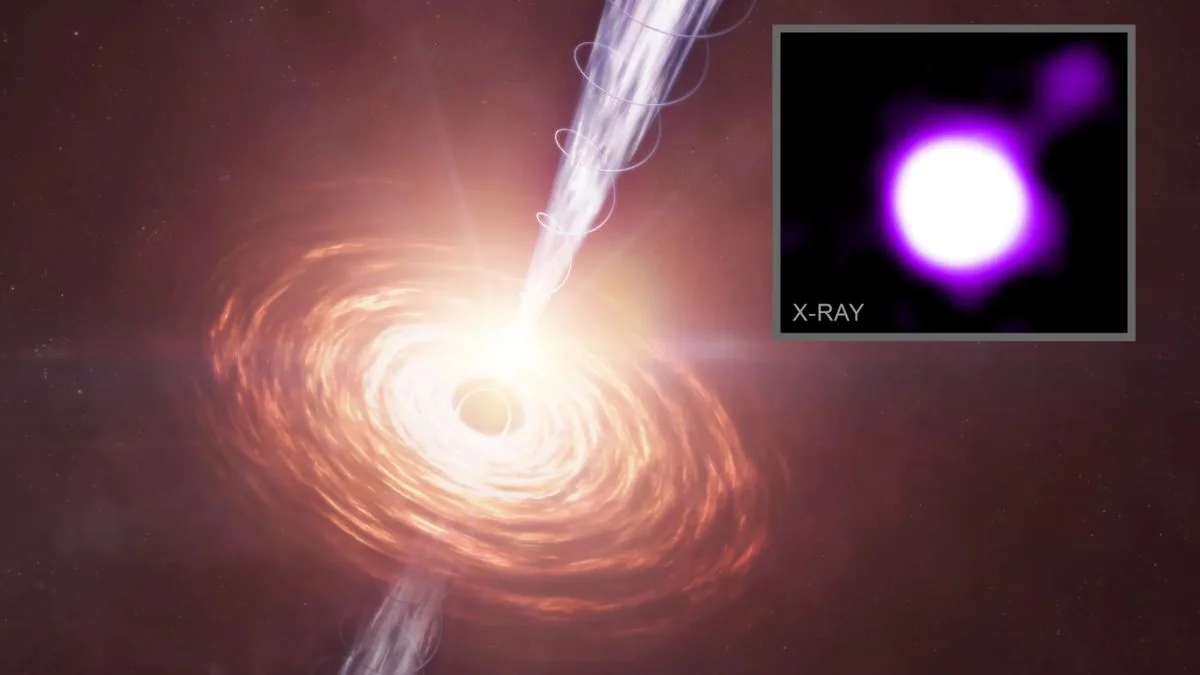
The universe is full of mysteries, and recent groundbreaking observations by NASA’s Chandra X-ray Observatory have revealed one of the most astonishing phenomena in recent times — a young exoplanet undergoing a rapid and unprecedented meltdown. This discovery not only challenges existing theories of planetary formation and evolution but also offers unprecedented insights into the volatile environments surrounding nascent planets. Let’s delve into the details of this cosmic event, its implications, and what it teaches us about the tumultuous lives of young exoplanets.
The Discovery: A Cosmic Meltdown
NASA’s Chandra X-ray Observatory has detected a young exoplanet that exhibits rapid shrinking—a process akin to a planetary meltdown—in a distant star system approximately 330 light-years away from Earth. This rare cosmic event was uncovered through high-energy X-ray imaging, which allowed astronomers to observe phenomena that are otherwise invisible in optical wavelengths.
The exoplanet, believed to be just a few million years old, is experiencing intense atmospheric loss, likely driven by its host star’s radiation and stellar winds. What makes this discovery extraordinary is the speed at which the planet is losing its atmosphere and mass, suggesting that planetary evolution can be far more dynamic and violent than previously thought.
Key Features of the Meltdown
- Rapid atmospheric erosion: The planet’s atmosphere appears to be melting away at an astonishing rate, exposing its rocky core to space.
- High-energy radiation impact: The intense X-ray emissions from the host star are likely accelerating atmospheric loss, creating conditions similar to a cosmic meltdown.
- Size reduction: Comparative observations indicate that the planet’s size is decreasing over a relatively short cosmic timescale, which is a rare phenomenon to observe in real-time.
This planetary meltdown challenges previous assumptions that young planets gradually stabilize over millions of years. Instead, it underscores that in some systems, planets may undergo rapid and catastrophic evolutionary phases early in their life cycle.
Understanding the Causes of the Meltdown
The Role of Stellar Radiation and Winds
The primary driver behind this planetary disintegration appears to be the intense radiation and stellar winds emitted by the host star. Young stars, especially in their formative years, are known to be extremely active, spewing high-energy photons and charged particles that can strip away the atmospheres of nearby planets.
In this case, the combination of ultraviolet and X-ray radiation from the star has energized the planet’s atmospheric particles, causing them to escape into space at an accelerated pace. The stellar winds, consisting of charged particles ejected from the star’s corona, further contribute to the stripping process, carving away the planet’s gaseous envelope.
Planetary Composition and Vulnerability
The observed planet is likely a gas-rich world, akin to a mini-Neptune or a super-Earth with thick atmospheres. Its proximity to the star and its early formation stage make it particularly vulnerable to atmospheric escape.
Analysis suggests that the planet’s core might be rocky or metallic, and as the gaseous envelope diminishes, the planet gradually reveals its denser interior. This process might explain the shrinking observed in the data and provides clues about the initial composition of such planets.
Implications for Planetary Formation Theories
Challenging Traditional Models
For decades, planetary formation models have posited that young planets stabilize within a few million years, developing protective atmospheres and orbital configurations that persist over billions of years. However, this new evidence suggests that planetary evolution can be far more turbulent—featuring rapid atmospheric loss and even possible planetary demise—especially in hostile stellar environments.
This discovery prompts scientists to reconsider the timeline of planetary stabilization. It indicates that planets may often face near-total atmospheric stripping early in their existence, which could influence their potential habitability and long-term evolution.
Understanding Planetary Diversity
The observation also highlights the diversity of planetary evolutionary paths. Some planets may retain their atmospheres and develop into habitable worlds, while others, like the one observed, may undergo destructive processes that drastically alter their structure and composition within a few million years.
Such insights are crucial for interpreting data from exoplanet surveys and understanding the wide spectrum of planetary types observed in our galaxy.
Future Research and Observations
The discovery opens new avenues for further investigation. Astronomers are now eager to identify similar events in other star systems and to monitor the ongoing disintegration processes in real time. Upcoming telescopes and space missions will play a vital role in capturing detailed data on planetary atmospheres and their evolution under stellar influence.
Additionally, computer modeling and simulations will be essential to predict the long-term outcomes of such planetary meltdowns and to understand the physical mechanisms driving atmospheric escape.
Potential for Detecting Other Meltdowns
- Enhanced high-energy observations using X-ray and ultraviolet telescopes will help identify more planets undergoing similar processes.
- Studying the characteristics of the host stars, especially their activity levels during formation, will provide context on the conditions that lead to planetary meltdown scenarios.
Broader Significance: What It Means for Our Search for Habitable Worlds
While this discovery might seem like a setback in the hunt for habitable exoplanets, it actually offers valuable insights. Understanding the destructive processes that can strip planets of their atmospheres informs us about the conditions necessary for planets to retain their hospitable environments.
Furthermore, it emphasizes the importance of stellar activity in planet habitability assessments. Not all planets are secure in their orbits, and many might be vulnerable to early atmospheric loss due to their star’s behavior.
Conclusion
The recent observations of a rapidly shrinking young exoplanet by NASA’s Chandra X-ray Observatory illuminate a volatile and dynamic phase of planetary evolution that was previously hidden from view. This cosmic meltdown not only challenges existing theories but also enriches our understanding of the complex interplay between stars and their planets.
As technology advances and our observational capabilities improve, we can expect to uncover more such phenomena, deepening our understanding of the universe’s intricate design and the myriad paths planets take toward their ultimate fate.
For more updated news please keep visiting Hourly Prime News.